For most of the last decade, "AI cybersecurity" meant using AI to defend.
Better anomaly detection. Smarter correlation. Fewer false positives. AI was something you added to the defensive side of the board.
That framing is now half the story, and it is the less urgent half.
The change: AI moved to the other side of the board
The meaningful development is not that defenders got AI. It is that attackers did, and that the cost of attacking collapsed as a result.
Consider what a serious intrusion used to require. Skilled people. Weeks of reconnaissance. Custom tooling. Patience, and the money to fund all of it. That cost structure was itself a form of security: it meant only well-resourced adversaries could afford to target you, and only if you were worth it.
Frontier-capable open models are downloadable today. Distilled variants ship without meaningful restriction. Uncensored builds are sold openly. The chain of work that used to need a team (enumerate the surface, find the weakness, write the exploit, move laterally, exfiltrate) can now be attempted by one person with a model and an afternoon.
The consequence is not that attacks became more sophisticated. It is that they became cheap enough to point at everyone. Targets that were previously not worth the effort now are, because the effort is close to zero.
The threat is not that AI attacks are smarter. It is that they are cheap enough to point at everyone, and fast enough to finish before anyone looks.
Why existing tools miss
Every security tool an enterprise owns was designed to alert a person.
That design choice runs deeper than any individual product. It shapes severity scoring, which exists to rank things for human attention. It shapes case management, which exists to route work to people. It shapes escalation, which exists to find the right human at the right hour. It shapes on-call rotations, dashboards and shift handovers.
All of it assumes the decisive action is taken by someone who read something.
Against an autonomous attacker, that assumption fails on timing alone. Enterprise response time is measured in hours. Autonomous attack time is measured in seconds. By the time someone responds, the attack is finished: not partially contained, finished.
This is why "we have EDR, SIEM and a 24/7 SOC" is not the reassurance it used to be. Those tools are genuinely good at what they were built for. What they were built for was a human-paced adversary.
What actually changes the outcome
Only two things close the gap: removing the human from the response path, and positioning defence where it can act rather than observe.
Removing the human from the response path does not mean removing human judgement. It means humans set and govern policy, while enforcement happens automatically. A person deciding "this class of behaviour is never allowed" in advance is far more useful than the same person deciding "block this specific connection" forty minutes late.
Positioning matters just as much. A tool that sees a copy of traffic can describe an attack. A control point the traffic passes through can end it. This is why the gateway model has become the practical answer: it is the only position from which a defence can act inside the attacker's timeframe.
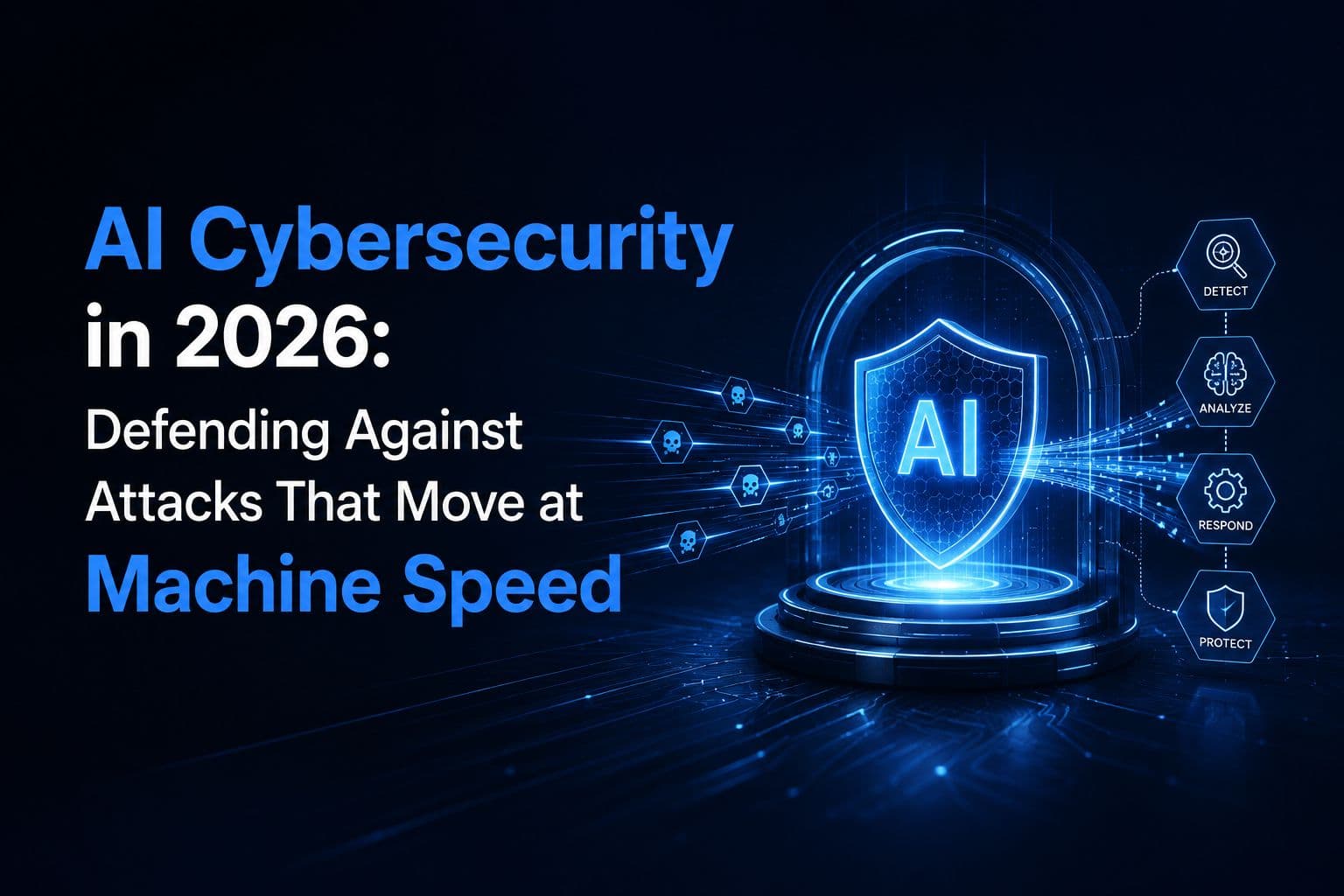
At Conux, five AI agents run that loop at the gateway. One detects. One blocks and writes the rule. One hardens the surface. One logs the evidence. One orchestrates the rest. Detect. Block. Adapt. Prove: with no queue in the middle.
The attacker most AI security ignores
There is a second adversary operating on a completely different clock, and AI-focused security programmes routinely leave it out.
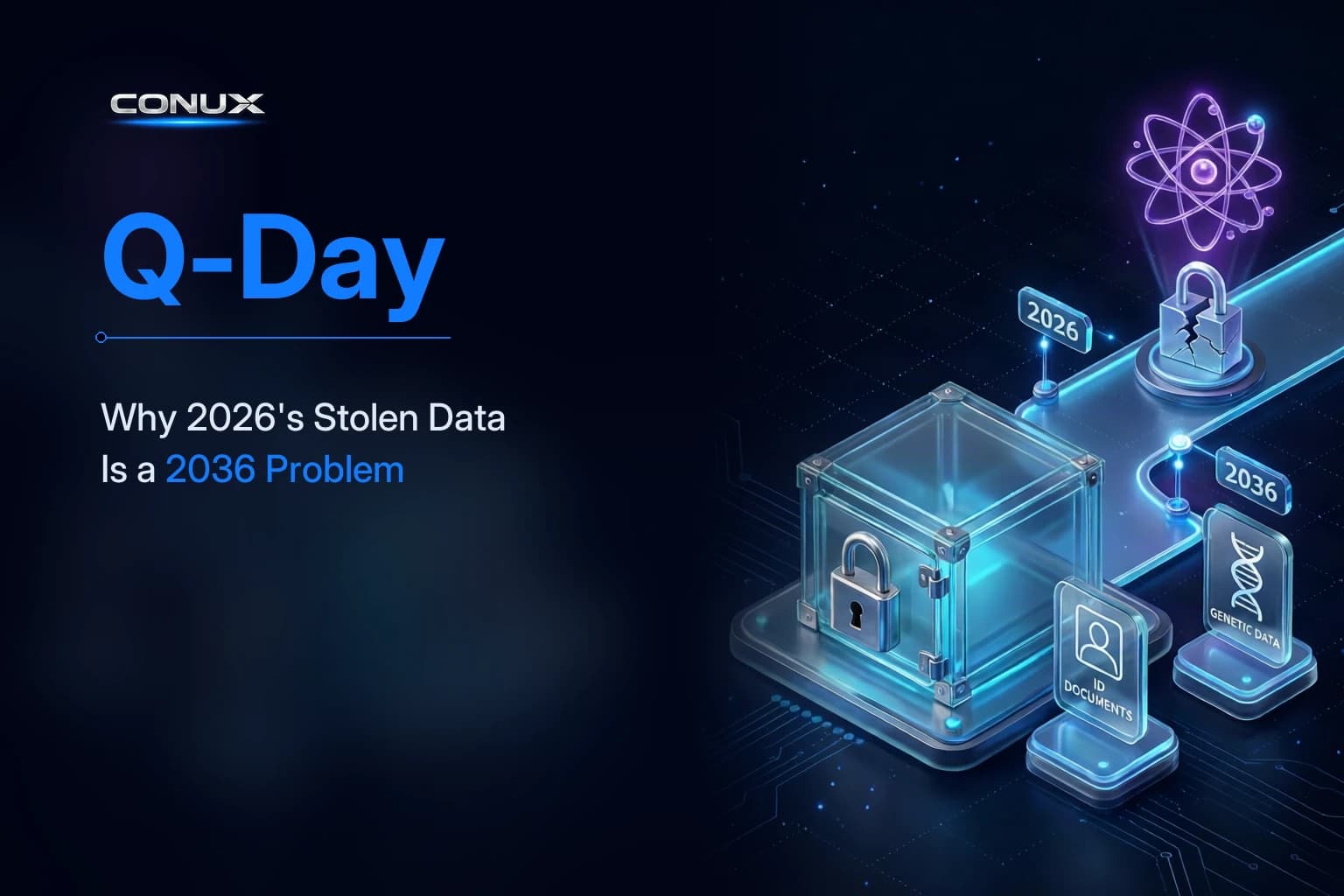
Nation-state actors are collecting encrypted enterprise traffic right now. They cannot decrypt it today. They are betting, reasonably, that they will be able to, and that a decade of stored traffic will become readable in a single event. Harvest now. Decrypt later. Exploit forever.
Unlike the AI threat, this one has a fixed date. CNSA 2.0 requires post-quantum cryptography from 2027. Canada, the EU, the UK and the UAE follow. There are no extensions.
Conux estimates the large majority of enterprises have no migration plan in place. Whatever the exact figure, the structural problem is clear: organisations that solve AI attack now and quantum later will buy two products and run two migrations, and the AI tool they buy today will not be the thing that satisfies the 2027 requirement.
The one-deployment argument
This is where the buying decision actually sits.
Buy AI security today and you replace it in 2027. Buy quantum security today and you are undefended tonight. The two attackers arrive on different timelines but converge on the same place: the connection.
A cybersecurity gateway answers both from one position. Every connection passes through it. There it stops autonomous attacks in seconds, applies quantum-safe encryption to everything, governs machine identities, enforces policy and produces audit evidence.
One deployment. Not two migrations.
And crucially, nothing gets ripped out. Existing cloud, identity, applications and AI models stay where they are; the gateway sits in the middle of them. Weeks to deploy, invisible to users.
A realistic first ninety days
Strategy documents about AI-era security tend to describe an end state without a route to it. This is a sequence that fits in a quarter.
Weeks one to three: inventory the traffic, not the tools. Most organisations have a reasonable list of applications and a poor picture of which systems talk to which. Map the connections, particularly service-to-service and anything touching AI infrastructure. This is unglamorous and consistently reveals things nobody expected: forgotten endpoints, over-scoped service accounts, internal APIs with no authentication.
Weeks three to five: classify controls honestly. Go through the security stack and label each control by what it does when it fires. Does it alert, or does it act? Anything whose decisive step is human review is investigative tooling, not a control against machine-speed attack. This exercise is uncomfortable and is usually the moment leadership understands the gap.
Weeks five to eight: establish an enforcement point. Place a gateway in front of the highest-risk surface identified in the inventory: for most organisations now, that is AI infrastructure, because it is newest, busiest with machine-to-machine traffic, and least governed. Verify machine identity per connection. Enforce a narrow policy about what may talk to what.
Weeks eight to twelve: turn on quantum-safe encryption and widen. Once every connection in that scope passes through a single point, applying post-quantum encryption is configuration rather than a migration programme. Then extend the same pattern to the next surface.
Two things to avoid.
Do not start with a full cryptographic inventory. It is valuable and it is slow, and organisations routinely spend two quarters producing a document while remaining exposed to an attacker operating today. Establish enforcement first; inventory improves what you do inside it.
Do not buy the AI problem and the quantum problem separately. The 2027 deadline is close enough that a tool purchased now without an encryption story will be replaced or supplemented before it has paid for itself.
The bottom line
AI cybersecurity stopped being a question about better detection some time ago.
The adversary got cheap and fast at the same moment that a second, quieter adversary started stockpiling your encrypted traffic against a deadline you cannot move. Neither is addressed by adding another tool that raises an alert for someone to read.
What changes the outcome is position and autonomy: enforcement placed where every connection passes, acting inside the attacker's timeframe rather than after it. Do that once and both attackers are answered from the same place, without a rebuild.