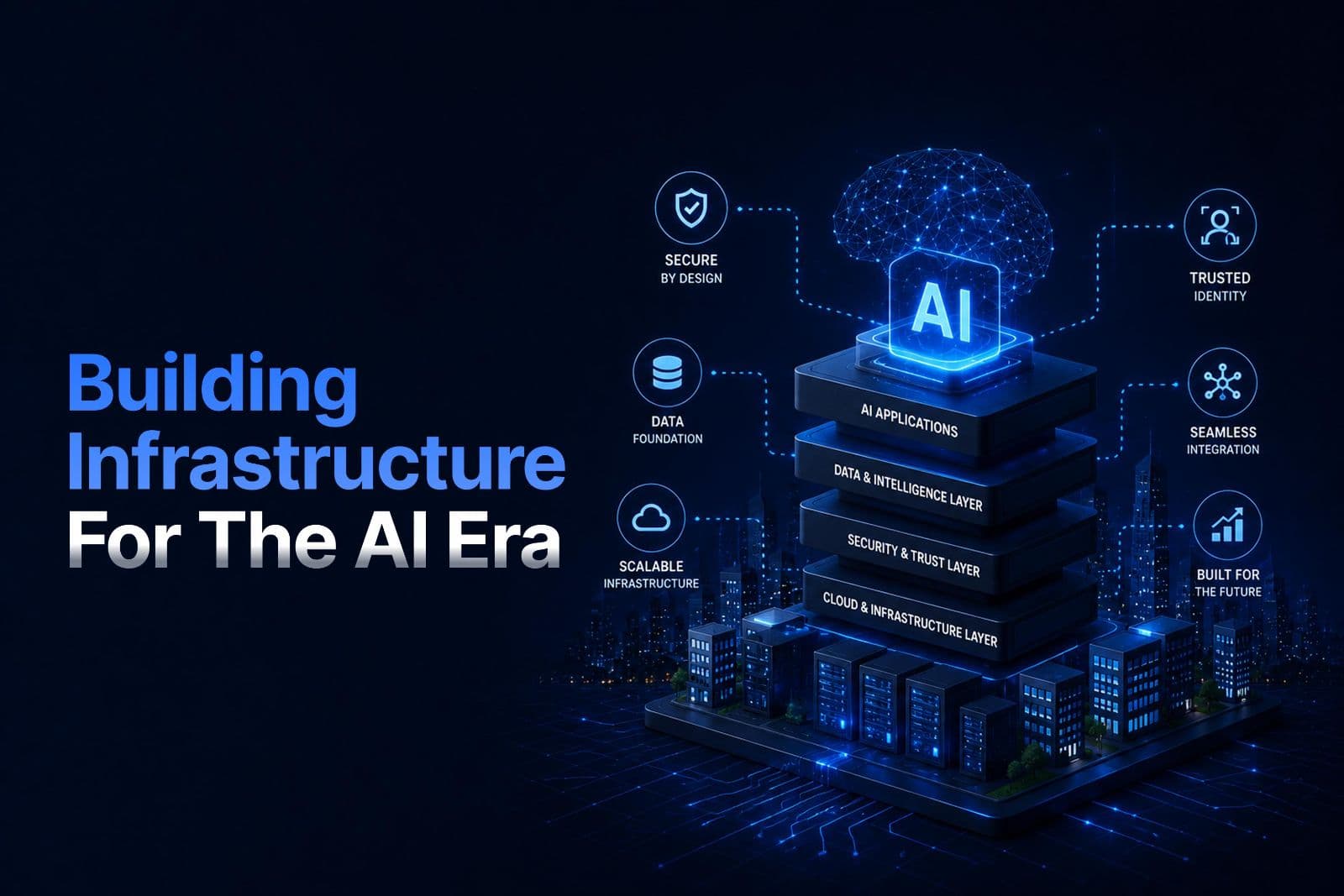
Every technological era is defined by the infrastructure built for it. The AI era's defining infrastructure will not be compute. It will be trust.
When we talk about AI infrastructure, the conversation usually means GPUs, data pipelines, and model-serving platforms, the machinery that makes AI run. That machinery matters, but it is not what makes AI safe to use in the real economy. It answers how AI computes, not whether its actions can be trusted.
The defining infrastructure of the AI era is the layer that lets autonomous systems be trusted to act: to authenticate, to be authorized, to be held accountable. Without it, all the compute in the world produces capability you cannot safely deploy. Building the AI era means building its trust infrastructure, and building it to last.
Compute Is Necessary, Not Sufficient
Raw AI capability is becoming abundant. What remains scarce is the infrastructure that makes that capability safe to unleash.
Compute and models are racing ahead and becoming commodities. But an enterprise cannot turn capability into value if it cannot trust the system to act without supervision. The gap between what AI can do and what an organization dares let it do is a trust gap, not a compute gap.
Infrastructure for the AI era has to close that gap. It is the difference between AI as a demo and AI as a dependable part of the business.
The Three Layers AI Actually Needs
A complete AI stack needs compute to run, data to learn, and trust to act, and the third layer is the one most organizations have not built.
We have invested heavily in the first two layers and almost nothing in the third. Yet acting, taking real-world actions with real consequences, is where AI creates and destroys value. The trust layer governs that action: who the agent is, what it may do, and whether it can be believed.
Until the trust layer is built, the AI stack is incomplete in exactly the place that matters most for autonomy.
Designing for Autonomy from the Start
Infrastructure built for human-supervised software fails when the software starts acting on its own.
Most existing infrastructure assumes a person initiates and approves. AI-era infrastructure must assume the opposite: machines initiating, deciding, and transacting at scale without a human in the loop. That assumption changes every requirement, from identity to audit.
Retrofitting human-era infrastructure for autonomy produces the brittleness enterprises see today. Building for autonomy from the start produces infrastructure that scales with the AI era instead of straining against it.
Quantum-Resilient by Construction
Infrastructure meant to define an era has to outlast the threats already visible, and the quantum threat is already visible.
Trust infrastructure for the AI era will be built on cryptography. Building it on primitives that quantum computing will break guarantees a rebuild within its own lifespan. Durable infrastructure assumes the quantum transition and is constructed to survive it.
Conux builds AI-era trust infrastructure as quantum-resilient by construction, so the foundation of the era does not expire partway through it.
The Builders Define the Era
Eras are shaped by whoever builds their foundational infrastructure. The AI era's foundation is trust, and it is being poured now.
The internet was defined by those who built its protocols, the cloud by those who built its platforms. The AI era will be defined by those who build its trust layer. That work is happening in this window, and the choices made now will hold for a long time.
Conux is building that foundation deliberately: a quantum-resilient trust layer designed for an economy of autonomous machines. The infrastructure of the AI era is trust, and we are building it.
The defining infrastructure of the AI era is trust. Conux is building it, quantum-resilient by construction. Talk to our team.