Most conversations about AI security are conversations about models.
Prompt injection. Jailbreaks. Output filtering. Hallucination. Alignment. All of it focused on what the model says and whether it can be manipulated into saying something it should not.
Meanwhile the model is running on something. And that something is where an attacker actually goes.
The layer nobody is guarding
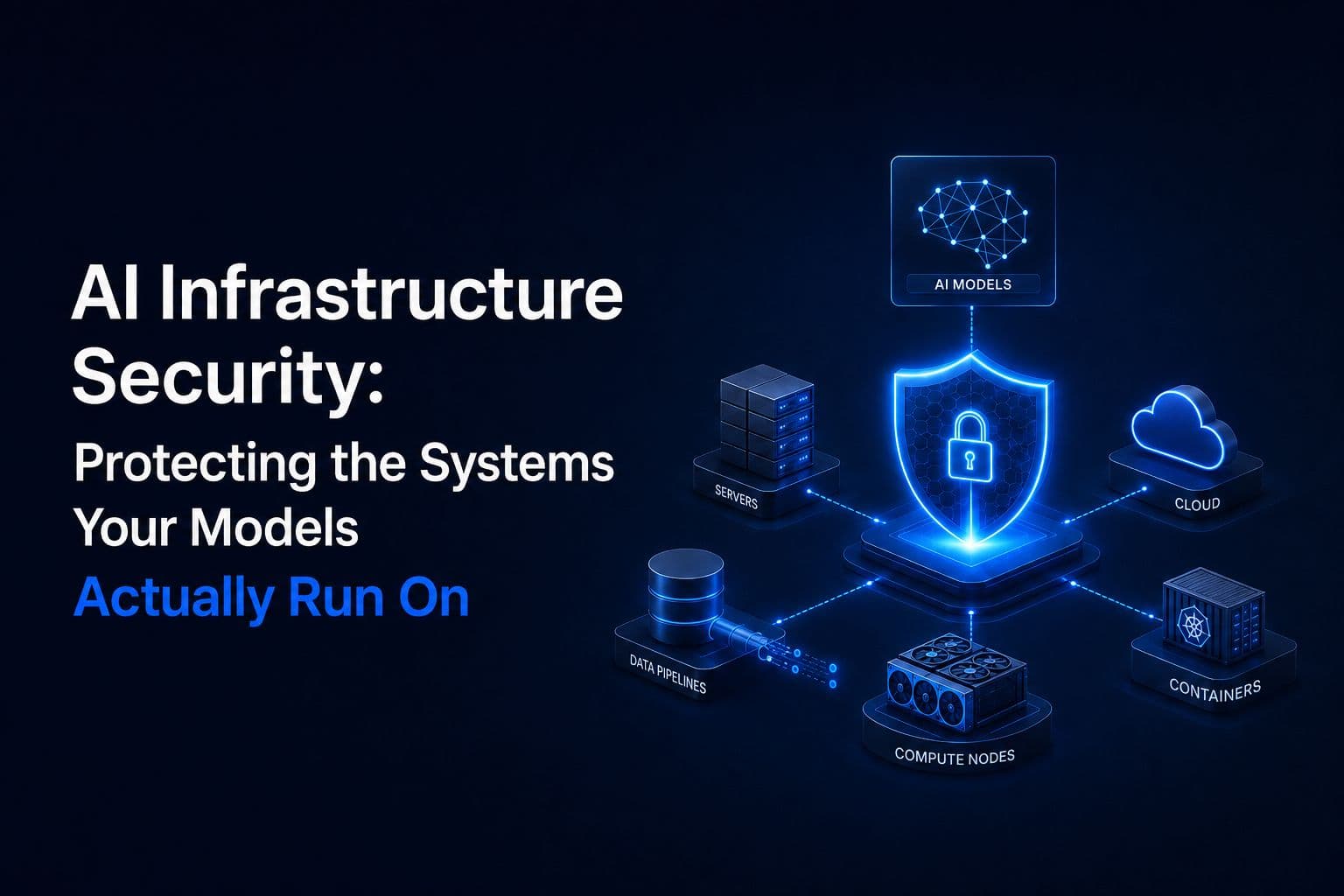
An AI system in production is not a model. It is a supply chain of infrastructure with a model somewhere in the middle.
There is a vector database holding embeddings of documents that were probably sensitive enough to be worth embedding. There is an inference endpoint accepting requests. There are orchestration services deciding which model gets called with what context. There are retrieval pipelines pulling from internal data stores. There are GPU nodes, queues, caches, feature stores and object storage. There are API keys and service credentials binding all of it together.
Every one of those is a conventional piece of infrastructure with a conventional attack surface. None of them are protected by anything you do to the model.
An attacker who wants your model's training data does not need to jailbreak the model. They can go and take the vector store. An attacker who wants to influence the model's answers does not need to craft a clever prompt. They can poison the retrieval source. An attacker who wants to use your model does not need an account. They can find the inference endpoint that someone exposed to make debugging easier.
Nobody breaks into the model. They walk into the infrastructure it depends on and take what the model was reading.
Why this surface is unusually exposed
AI infrastructure has three properties that make it a softer target than the rest of the estate.
It was built fast. AI systems moved from experiment to production faster than any recent category of enterprise software. Things built at that pace inherit the security posture of a prototype, and the review that would normally happen between the two stages often did not.
It is machine-to-machine. Almost all of this traffic is service calling service. No human is present. Most enterprise security is architected around human users: authentication flows, session management, device posture, access reviews. Traffic with no human in it slips past controls that were designed assuming one.
It is credential-dense. Retrieval pipelines and orchestration layers need access to a lot of systems to be useful. That concentrates high-value credentials in exactly the components built fastest and watched least.
Put those together and you get a surface that is rich, busy, poorly instrumented, and largely invisible to controls built for people.
Why autonomous attackers find it first
This surface is a particularly good match for an automated adversary.
An autonomous attacker enumerates. It does not need a hypothesis about your architecture; it tries everything in parallel and keeps whatever responds. Exposed endpoints, permissive service accounts, unauthenticated internal APIs and over-scoped credentials are precisely what that behaviour surfaces, and AI infrastructure tends to have all four.
And it happens at a speed the response process cannot match. Enterprise response time is measured in hours. Autonomous attack time is measured in seconds. A finding that goes into a queue is a finding that arrives after the fact.
What actually protects it
The common thread across every component listed above is that they talk to each other. The vector store is reached over a connection. The inference endpoint is called over a connection. The retrieval pipeline pulls over a connection.
That is the surface, and it means the effective control point is the connection, not the component.
A cybersecurity gateway sits where every connection passes. Nothing enters, nothing leaves, and nothing moves between systems without going through it. At that point it can do the things component-level hardening cannot do consistently:
Verify machine identity at connection time. Every service, workload and agent proves what it is before it is allowed to talk to anything. Not a credential in a config file: an identity checked in the path.
Stop autonomous attacks in seconds. Blocking the connection and writing the rule that keeps it blocked, rather than raising an alert nobody reads in time.
Encrypt everything in transit, including quantum-safe. Applied uniformly, without every pipeline team implementing cryptography correctly on their own.
Enforce policy automatically. "This orchestration service may reach this vector store and nothing else" becomes enforced rather than intended.
Produce audit evidence as a by-product, which matters when you are asked to demonstrate control over AI systems to a regulator.
The deadline attached to the second attacker
There is a second adversary in this picture, and AI infrastructure is unusually exposed to it.
Nation-states are collecting encrypted enterprise traffic today to decrypt once quantum matures. Harvest now. Decrypt later. Exploit forever. The value of that stored traffic depends on how long the data stays sensitive, and the material moving through AI infrastructure is embeddings of proprietary documents, internal knowledge and customer data. That does not expire.
CNSA 2.0 mandates post-quantum compliance in 2027, with Canada, the EU, the UK and the UAE following. Applying quantum-safe encryption pipeline by pipeline across an AI estate is a programme. Applying it at the gateway every connection already passes through is a deployment.
One gateway. Two attackers. No rebuild: existing cloud, identity, applications and models stay where they are.
An inventory exercise worth running this week
Before deciding on architecture, it is worth establishing how exposed the current AI estate actually is. This exercise takes a few days and consistently surfaces things nobody expected.
List every component, not every model. For each AI system in production, enumerate the vector stores, inference endpoints, orchestration services, retrieval pipelines, feature stores, queues, object storage and GPU nodes it depends on. The list is usually longer than the team expects, because components were added incrementally.
For each component, answer four questions.
Who can reach it? Not who is supposed to: who can. Network reachability, not policy intent.
How does it authenticate callers? If the answer is a shared secret in configuration, note when it was last rotated. If nobody knows, that is the answer.
What can its own credentials reach? Retrieval and orchestration layers are typically over-scoped because narrow scoping was harder during development. This is where blast radius lives.
Is its traffic encrypted, and with what? Include internal service-to-service traffic, which is frequently plaintext on the assumption that the network is trusted.
Then ask the uncomfortable question: if an attacker obtained this component's credentials, what would they reach? Do it for the retrieval pipeline first: it usually has the broadest access and the least review.
What the exercise typically reveals. Inference endpoints exposed during testing and never closed. Service accounts with permissions from an earlier architecture. Internal APIs with no authentication because they were "internal". Vector stores holding embeddings of documents nobody realised had been indexed. Secrets shared across environments.
None of these are exotic. They are the ordinary consequence of building quickly, and they are exactly what an autonomous attacker enumerating in parallel will find first.
The output is not a remediation backlog to work through component by component: that is a programme, and the attacker is operating now. The output is a map of connections, which tells you where a control point delivers the most coverage soonest.
The bottom line
The model is the part of an AI system everyone looks at. The infrastructure is the part attackers go through.
Vector stores, inference endpoints, orchestration layers and retrieval pipelines were built fast, talk to each other constantly without a human present, and hold the credentials that make everything else reachable. That combination is unusually attractive to an adversary that enumerates rather than reasons.
Because every one of those components is reached over a connection, the connection is where the control belongs: verified identity, enforced policy, quantum-safe encryption and automatic evidence, applied once rather than negotiated per pipeline.