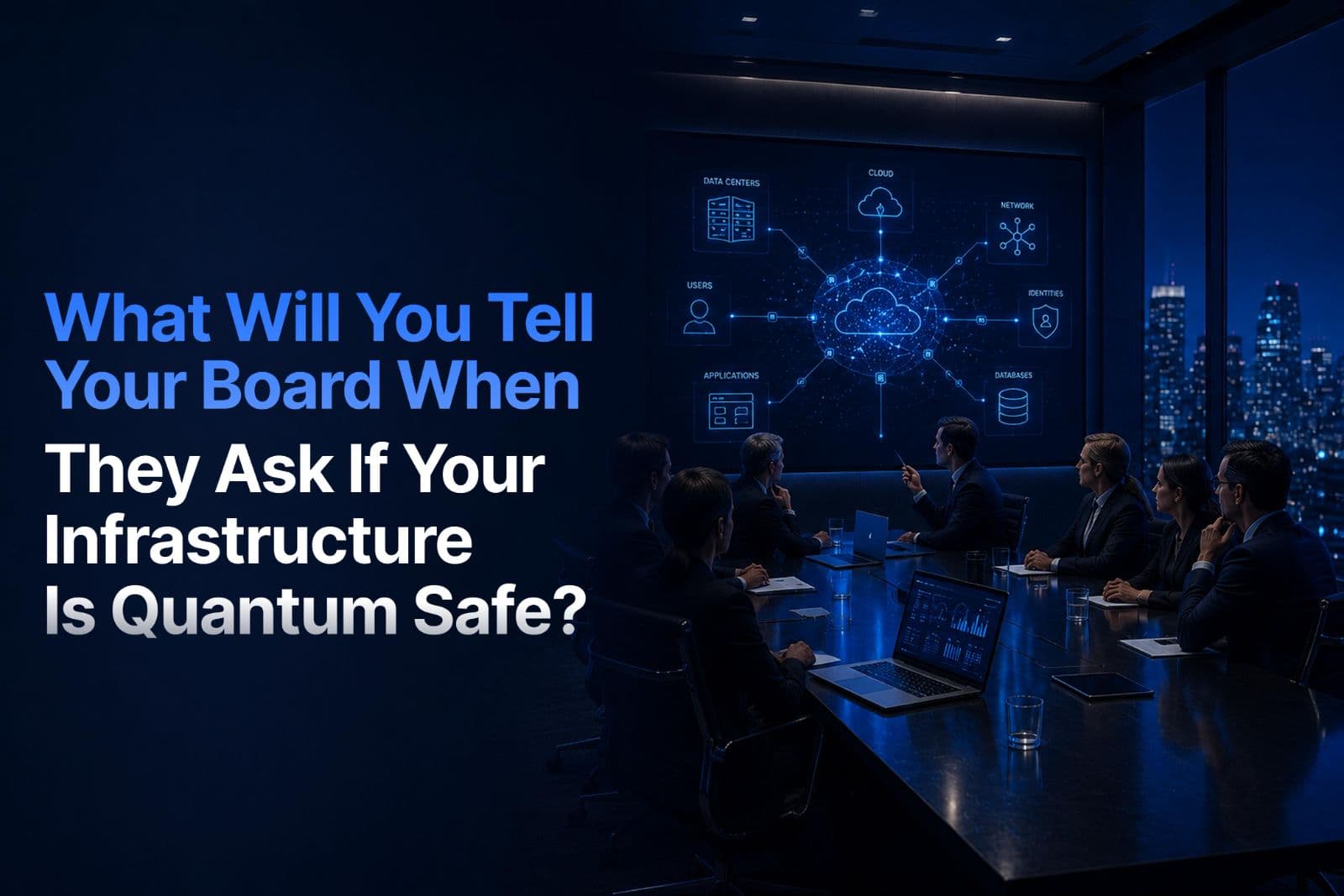
It's going to happen in a board meeting you didn't plan for.
Maybe a director read something in the FT about the NSA's quantum security mandate. Maybe your largest enterprise client sent a questionnaire asking about your cryptographic posture. Maybe a regulator included a new line in your annual examination about post-quantum readiness.
Someone in that room is going to ask: "Are our critical systems quantum safe?"
And the answer that most critical infrastructure operators would honestly have to give right now is some version of: "We're working on it."
That answer won't hold indefinitely. And the organizations that have a different answer (a confident, documented, demonstrable answer) will occupy a very different position in the conversations that follow.
Critical infrastructure cybersecurity has always demanded board-level attention. The quantum dimension has made that attention more urgent, more specific, and more consequential than ever before.
The Threat Model That Changed Everything
For decades, critical infrastructure cybersecurity was about keeping adversaries out: firewalls, network segmentation, access controls, incident response. The assumption was that if you could detect and block intrusion attempts, you were protected.
Quantum computing changes that model fundamentally. Not because it makes intrusion easier, but because it makes the encryption protecting your operational systems retroactively vulnerable.
Here's what is happening right now, whether or not it appears in your security team's incident dashboard: nation-state adversaries are systematically collecting the encrypted communications of critical infrastructure organizations (power grid control systems, financial clearing networks, hospital data systems, pipeline management communications) and archiving them for future decryption.
The collection requires no intrusion. It requires access to the network paths that traffic travels, which sophisticated state actors have demonstrated they possess. The decryption isn't possible today. It becomes possible when quantum computing technology reaches the necessary threshold, which most credible estimates place within 5 to 15 years.
This is what makes the quantum threat to critical infrastructure different from every previous cybersecurity threat. It isn't about a breach that hasn't happened yet. It's about data that has been compromised in a form that can't yet be read. The exposure is present tense. The consequence is near future.
The Five Sectors Where This Conversation Is Happening Right Now
Energy and utilities operators are navigating a specific tension: the industrial control systems that manage their infrastructure have operational lifespans measured in decades, but the cryptographic assumptions they were built on will not survive the quantum era. A control system installed in 2015 with a 25-year lifespan was not designed for post-quantum security. The question of how to protect those systems without replacing them is one of the most operationally complex problems in critical infrastructure cybersecurity.
Financial services leaders are dealing with a different version of the problem. Financial data carries inherent long-retention requirements. Transaction records, audit trails, and client communications that must be preserved for 7 to 10 years are exactly the kind of long-lived data that harvest-now-decrypt-later attacks target. The competitive and regulatory consequences of a future quantum decryption of historical financial communications are significant.
Healthcare executives face perhaps the starkest version of the exposure: patient records with lifetime confidentiality requirements, pharmaceutical research with long competitive horizons, and clinical trial data with decade-long significance. All transmitted under encryption that quantum computing can eventually break, all subject to HIPAA retention requirements that keep them relevant long after quantum capability arrives.
Telecom leadership is contending with the fact that their infrastructure carries the communications of every other critical sector. A quantum-capable adversary who has harvested telecom management traffic can eventually reconstruct network topology, authentication infrastructure, and operational patterns for active exploitation. The communications don't even have to be the primary target. The metadata and operational signals are valuable in themselves.
Government contractors face the hardest deadline: the NSA's CNSA 2.0 mandate requires post-quantum cryptography for national security systems by January 2027. That's not a suggestion or a planning target. For enterprises in scope, it's a contractual requirement with real procurement consequences.
What the Most Prepared Organizations Are Doing Differently
The critical infrastructure organizations that are getting quantum security right share one thing that isn't about technology: leadership has decided this is a business risk issue, not a security team issue.
That decision changes the organizational dynamics completely.
When quantum-safe readiness is a security team initiative, it competes for budget with every other security initiative, gets scoped by technical feasibility rather than business consequence, and produces deliverables that don't translate to board-level risk reporting.
When it's a business risk issue, it gets a cross-functional team, a board-visible risk register entry, a budget process that starts from consequence rather than technology cost, and a migration timeline driven by regulatory obligation and business priority rather than technical convenience.
The specific things those organizations are doing:
They know what they have. A complete inventory of every encryption-dependent system, protocol, and data flow in their infrastructure (including the operational technology environments, vendor access channels, and third-party integrations that are often outside the scope of standard security programs). You cannot prioritize what you can't see.
They're migrating in priority order, not convenience order. The systems protecting the most sensitive, longest-lived data migrate first, regardless of how technically convenient the migration is. This requires business judgment about consequence, not just technical assessment of complexity.
They're building for adaptability, not just for today's standard. The organizations that will handle the quantum era well are building crypto agility into their security architecture: the ability to update cryptographic algorithms across their estate through policy, not through individual system changes. Because the standards will evolve. The threat will evolve. The organizations that can adapt without emergency migrations are the ones that stay ahead.
The Organizational Consequence Nobody Models
The technical and regulatory risks of quantum vulnerability in critical infrastructure are increasingly well-documented. There is a third category of consequence that is harder to model but potentially more significant: the organizational trust consequence.
When the quantum computing era arrives (and it will arrive) there will be a moment of widespread assessment. Regulators, enterprise clients, partners, and the public will want to know which organizations were ready and which were caught flat-footed.
Critical infrastructure operators that can demonstrate documented, audited, continuous quantum readiness will occupy a fundamentally different trust position than those that cannot. They will face easier regulatory reviews, more confident enterprise client relationships, and the operational resilience that comes from having addressed the risk systematically rather than reactively.
Those that cannot will face something else: the combination of retroactive data exposure, emergency compliance remediation, and the long shadow of having been unprepared for a threat that was widely publicized for years.
That trust consequence is earned by decisions made now. Not when the mandate tightens. Not when a peer organization's exposure becomes a cautionary tale. Now, while the window is open and there is time to move systematically rather than under fire.
The Answer Your Board Deserves
The board member who asks whether your infrastructure is quantum safe is not asking for a technical briefing. They're asking whether the organization they're responsible for governing is prepared for a documented, credentialed, regulatory-grade risk that has a hard timeline.
The answer that builds confidence (for the board, for your regulator, for your enterprise clients) has three parts. Here's what you've assessed and where you're exposed. Here's the priority order of what you're protecting and why. Here's when you'll be complete and how you'll demonstrate it.
CONUX AI provides the orchestration layer that makes that answer achievable: automated discovery of cryptographic exposure across IT and OT environments, protection deployed at the infrastructure level without disrupting operational systems, and one-click compliance reporting that turns your quantum readiness posture from an internal project into an auditable, demonstrable fact.
The board question is coming. The answer depends on when you started working on it.