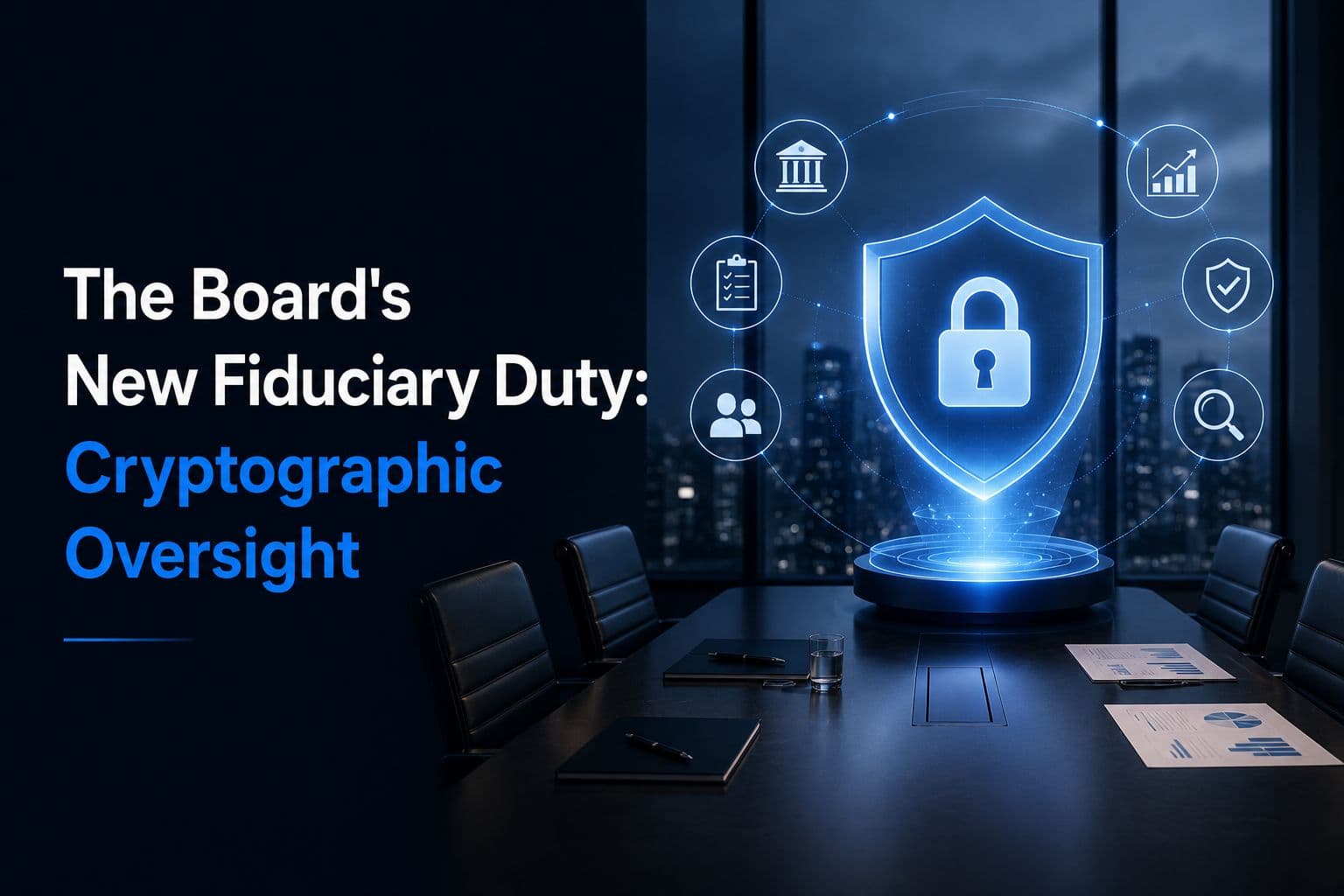
Boards oversee financial risk, operational risk, and cyber risk. Cryptographic risk is quietly becoming the next item they cannot afford to ignore.
Corporate boards have steadily expanded their oversight as new categories of material risk emerged: financial controls after accounting scandals, cyber risk after a decade of breaches. Each became a board-level duty once the consequences of ignoring it grew large enough. Cryptographic risk is crossing that threshold now.
The quantum transition turns cryptography from a technical detail into a material business risk: data exposure, compliance failure, and the integrity of the systems the business runs on. Boards that treat it as an IT problem are making the same mistake earlier boards made with cybersecurity, right up until it became a fiduciary duty. The smart boards are getting ahead of it.
How Risks Become Board Duties
A risk becomes a board responsibility when ignoring it stops being a technical oversight and starts being a failure of governance.
Cybersecurity made this journey within memory: once dismissed as IT's concern, it is now a standing board agenda item with disclosure obligations and personal accountability. The trigger was materiality, breaches became large enough to threaten the whole enterprise.
Cryptographic risk is on the same trajectory. As the quantum transition makes it material, oversight of it becomes part of the board's duty of care, not an optional technical briefing.
Why Cryptographic Risk Is Material
Cryptography protects the confidentiality, integrity, and trust the entire business depends on. When it is at risk, the business is at risk.
Customer data, financial transactions, intellectual property, and the trust relationships that hold operations together all rest on cryptography. A failure in that layer is not a contained technical incident; it is a systemic exposure that reaches every part of the enterprise.
The harvest-now-decrypt-later threat sharpens the point: data being captured today is exposed the moment cryptography falls, which means the materiality is present now, not at some future Q-Day.
What Oversight Actually Requires
Cryptographic oversight does not require the board to understand the math. It requires the board to ask the right questions and demand evidence.
Boards do not audit financial statements line by line; they ensure controls and evidence exist. Cryptographic oversight works the same way: does the organization know where its cryptography lives, does it have a plan for the quantum transition, and can it prove progress?
The duty is governance, not engineering. The board's job is to make sure the capability and the accountability exist, and to fund them.
The Cost of Inaction Falls on the Board
When cryptographic risk materializes, the question asked of leadership will be the same one asked after every avoidable breach: did you know, and what did you do?
Regulators and shareholders increasingly hold boards accountable for foreseeable, material risks that were not addressed. The quantum transition is foreseeable and well-documented. A board that did not oversee it will struggle to explain its inaction after the fact.
Getting ahead of cryptographic oversight is not just prudent risk management; it is protection for the board itself.
From Awareness to Governance
The boards that act early will turn cryptographic risk from a looming liability into a governed, well-managed certainty.
The move is to put cryptographic risk on the board agenda now: assign accountability, require a quantum-readiness plan, and demand measurable progress. That converts an unmanaged exposure into a governed program, exactly what boards exist to ensure.
Conux gives boards and their executives the foundation to make cryptographic oversight tangible: visibility, a quantum-resilient roadmap, and evidence of progress.
Cryptographic oversight is becoming a fiduciary duty. Conux gives boards the visibility and roadmap to govern it, let's talk.