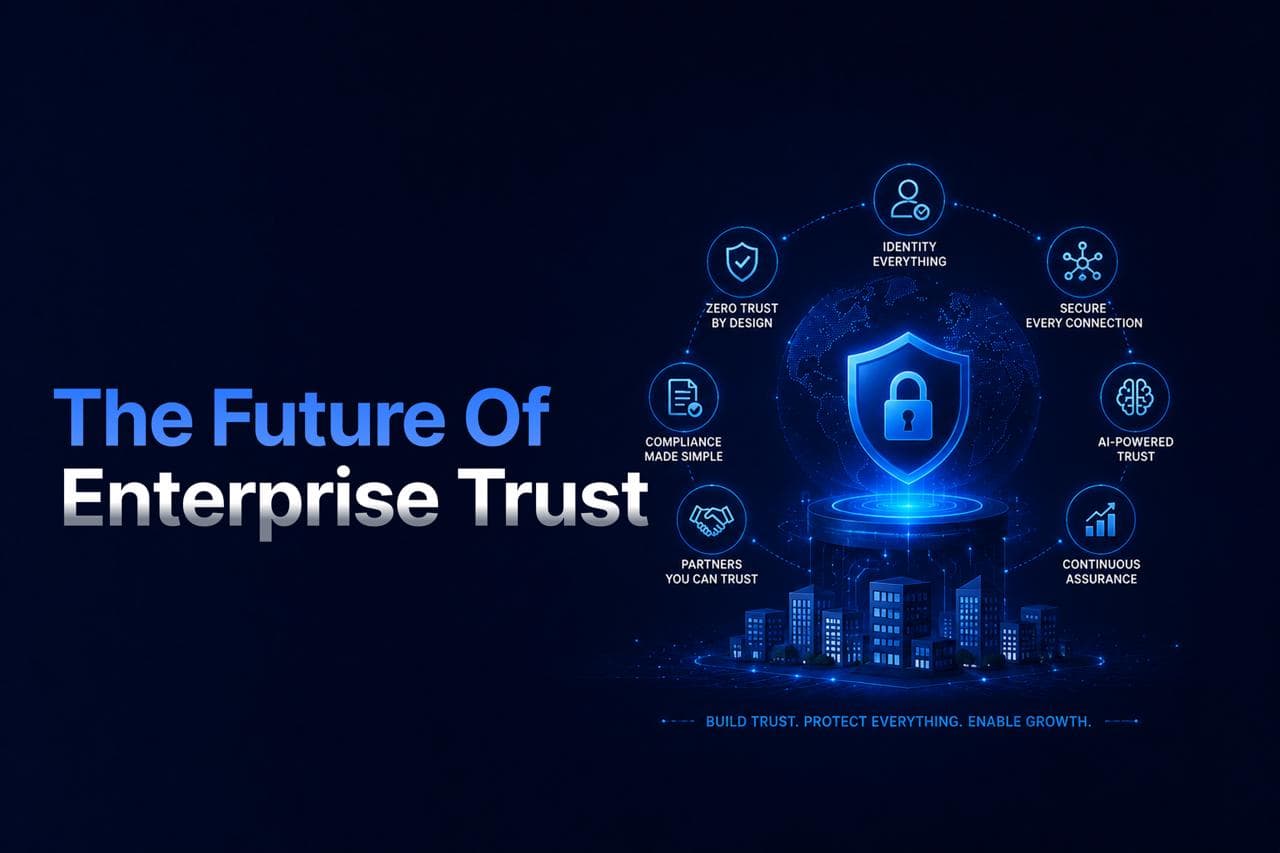
Enterprise trust used to be a relationship between people and institutions. It is becoming a property of infrastructure, measurable, automatic, and continuous.
For most of business history, trust inside an enterprise was social and procedural: you trusted colleagues, signed contracts, and relied on institutions to enforce them. Technology digitized the paperwork but left the model intact, trust as something granted, periodically reviewed, and largely assumed between checks.
That model is ending. In an enterprise where machines act continuously and autonomously, trust cannot be a periodic grant. It has to be a live property of the infrastructure itself, verified on every interaction, for every actor, human or machine. The future of enterprise trust is continuous, cryptographic, and built in.
From Granted to Verified
The old model granted trust once and assumed it held. The new model verifies trust on every interaction, because the actors and conditions never stop changing.
Annual access reviews and standing permissions made sense when change was slow and actors were human. In a machine-paced enterprise, trust granted on Monday may be wrong by Tuesday, a key rotated, an agent compromised, a permission outgrown.
Continuous verification replaces the periodic grant. Every actor proves itself every time, so trust reflects reality now rather than a decision made months ago.
Trust Becomes Measurable
You cannot manage what you cannot measure, and for the first time, trust becomes something an enterprise can measure precisely.
When trust is cryptographic and continuous, it produces evidence: which actors are verified, what authority they hold, whether their integrity is intact. Trust shifts from a feeling leaders assert to a state the enterprise can observe and prove.
That measurability is transformative. Boards can be shown trust posture the way they are shown financial posture, as data, not assurance.
Trust That Spans Organizations
The future enterprise does not operate alone. Its trust layer has to reach across partners, suppliers, and the agents acting between them.
Autonomous business is inter-organizational by nature: your agents transact with theirs. Trust confined to your own walls is insufficient when the interaction crosses boundaries. The trust layer has to be a fabric that extends to every counterparty.
This is why trust is becoming shared infrastructure rather than a private control. Its value grows as more participants can verify each other on common, cryptographic terms.
The Quantum Requirement
Continuous, cryptographic trust is only as trustworthy as the cryptography under it, which must survive the quantum era.
Every verification in this model is a cryptographic operation. If the underlying primitives become forgeable, continuous verification becomes continuous false assurance. The future of enterprise trust is unbuildable on quantum-vulnerable foundations.
Conux builds enterprise trust to be quantum-resilient by design, so that "verified" continues to mean verified after the cryptographic landscape shifts.
What Leaders Should Do Now
The enterprises that build continuous, measurable, quantum-resilient trust now will operate with a confidence their competitors cannot manufacture later.
The move is to stop treating trust as a static grant and start building it as live infrastructure, and to do it while the quantum transition is forcing a cryptographic rebuild anyway. The timing aligns the necessary with the strategic.
Conux gives leaders that foundation: enterprise trust as a continuous, measurable property of the infrastructure, ready for the AI economy and the quantum era.
The future of enterprise trust is continuous, measurable, and quantum-resilient. Conux is building it, start the conversation.