The phrase usually shows up first on a slide. Someone in security adds "post-quantum cryptography" to a risk register, and for a while it sits there: a line item nobody fully owns, filed somewhere between "emerging" and "someday."
Then someone with budget authority reads it and asks the only question that matters: "In plain English, what is post-quantum cryptography, and are we exposed?" That is the moment the topic stops being a technical curiosity and becomes a leadership responsibility. This guide answers that question the way a board needs to hear it.
"The models are new. The cryptography underneath them is not, and that gap is the most expensive blind spot in enterprise security today."
What Post-Quantum Cryptography Actually Is
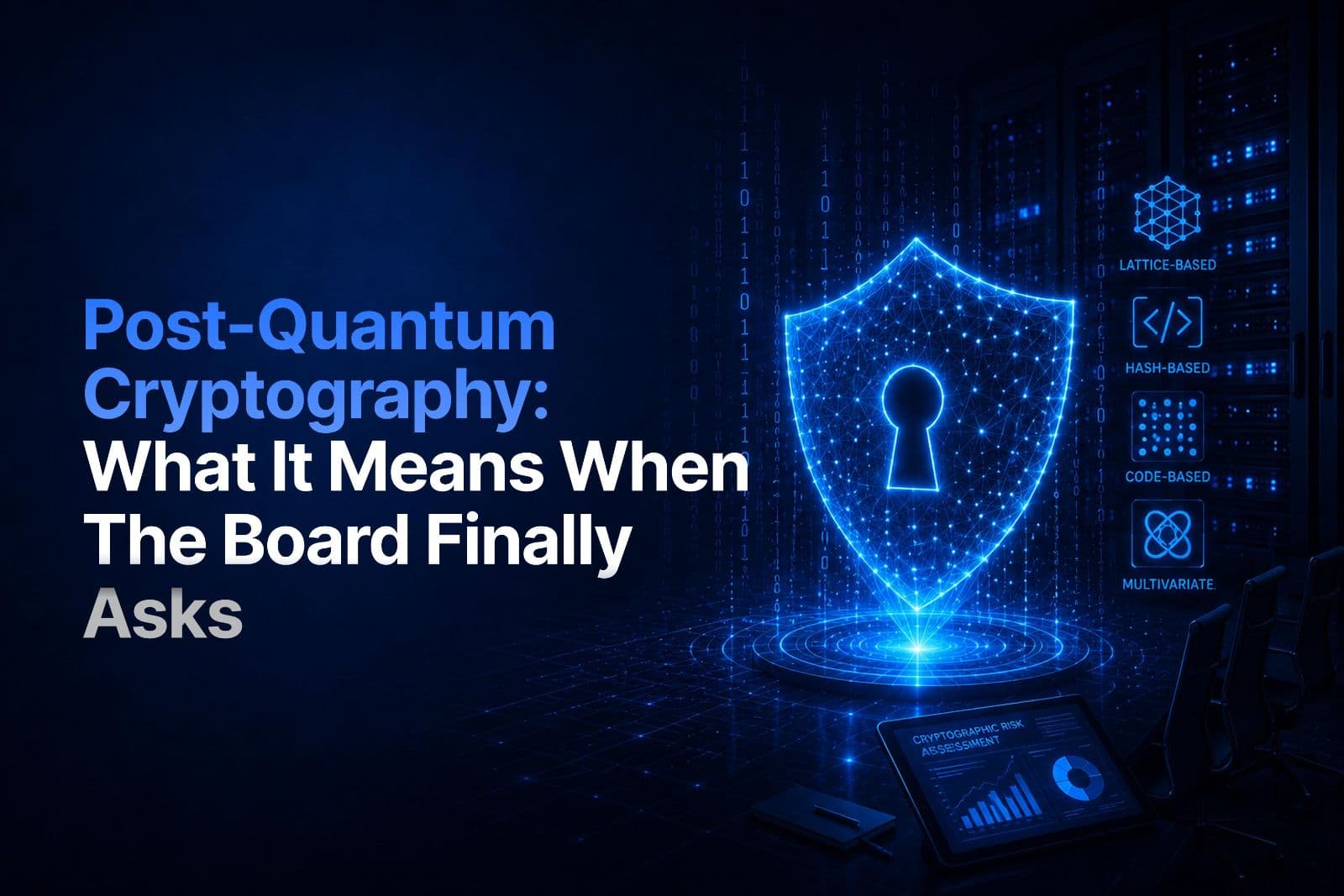
Post-quantum cryptography is a new generation of encryption designed to stay secure even against quantum computers. The encryption protecting your enterprise today (the math behind RSA and elliptic-curve cryptography) was built for a world of classical computers. A sufficiently powerful quantum computer breaks that math, not slowly but decisively.
Post-quantum cryptography replaces the vulnerable parts with algorithms a quantum computer cannot unravel. The important detail for leaders is that this is no longer theoretical: in August 2024, the U.S. National Institute of Standards and Technology (NIST) finalized the first post-quantum cryptography standards: ML-KEM (FIPS 203), ML-DSA (FIPS 204), and SLH-DSA (FIPS 205). That date turned a research topic into a published standard with a regulatory timeline attached.
If you want the one-sentence version for a board: post-quantum cryptography is the encryption that survives quantum computing, and the standards for it already exist.
Why Post-Quantum Cryptography Became Urgent While Everyone Watched AI
Most enterprises spent the last two years pouring attention and budget into AI. That was the right instinct, but it created a blind spot. Every AI system you deployed runs on data that moves across the same encryption quantum computing is about to make obsolete. The models are new. The cryptography underneath them is not.
So the urgency isn't abstract. The same momentum that made AI a board-level priority is exactly why the cryptographic foundation beneath it now deserves the same scrutiny. Post-quantum cryptography is not a competing initiative to your AI strategy. It is the thing that keeps your AI strategy from sitting on sand.
The "Harvest Now, Decrypt Later" Reality
Here is the part that surprises executives: you don't have to wait for a quantum computer to exist to be at risk today. Adversaries are already collecting encrypted data and storing it, betting they will decrypt it once the hardware matures. Anything you transmit now that must stay confidential for a decade is, in effect, already exposed.
That reframes the whole conversation. The question isn't "when will quantum computers arrive?" It's "how long does our data need to stay secret, and have we already lost that bet?" For sectors like finance, healthcare, and government, where confidentiality obligations run for years or decades, the honest answer is uncomfortable.
What the Regulatory Clock Already Says
Post-quantum cryptography is not just a good idea. It is becoming a requirement. The NSA's CNSA 2.0 guidance sets expectations for adopting quantum-resistant algorithms with key milestones landing in 2027, moving toward broad mandates by 2030. By most industry estimates, the overwhelming majority of enterprise systems (cited by CONUX at roughly 97%) are not yet prepared for those standards.
That gap between a fixed deadline and an unprepared estate is the entire opportunity. Organizations that treat 2027 as a planning anchor today turn a looming mandate into a funded, manageable program rather than a year-end emergency.
The One Question Your Board Will Ask Next
Once a leadership team understands the above, the follow-up is always the same: "What is our actual exposure, and what is the plan?" Not a technical briefing. A clear answer in terms of customer data, regulatory liability, and the timeline to fix it.
An organization that can answer that confidently isn't one that has finished its post-quantum cryptography migration. It is one that decided to hold the question early, assigned an owner, and produced a real inventory of its cryptographic exposure before the answer became an emergency. That posture (not the completion of any single project) is what "quantum ready" actually means.
The Difference Between Aware and Ready
Most boards are already aware. Awareness is the easy part. A memo, a headline, a vendor pitch can produce it. Readiness is something else entirely, and the distance between the two is where most enterprises quietly live.
A ready organization can answer three questions on demand: what cryptography do we run, where is it most exposed, and what is our schedule to fix it? An aware organization can answer none of them, but feels protected because the topic has been discussed. That false comfort is its own risk. It postpones the work while the exposure window stays open.
Closing the distance doesn't start with technology. It starts with a decision to treat the question as owned rather than acknowledged, and to fund a real inventory rather than another briefing.
Why the Cost of Waiting Compounds
Delay is rarely a single decision. It's a series of reasonable deferrals: next quarter, after the audit, once the budget cycle resets. Each one feels harmless in isolation. Together they consume the exact runway the 2027 timeline assumes you'll use wisely.
Every month spent deciding is a month of sensitive data still flowing through cryptography on a countdown. And under harvest-now-decrypt-later, a month of that data being collected for future decryption. The cost of waiting isn't static. It accrues quietly, and it is paid later, all at once, on a date you don't control.
The organizations that escape this pattern are not the ones with the biggest budgets. They are the ones that converted a vague awareness into a single owned program early, while the timeline still offered room to move deliberately instead of reactively.
The First Step Is Smaller Than the Fear
The scale of the problem can be paralyzing, which is itself a reason organizations stall. But the first step is not a multi-year migration. It is a single, fundable decision to inventory what you have. Everything else follows from that one artifact. Boards fund clear first steps far more readily than open-ended transformations, and a cryptographic inventory is exactly that kind of step: bounded, concrete, and immediately useful as the foundation for every decision that comes after it.