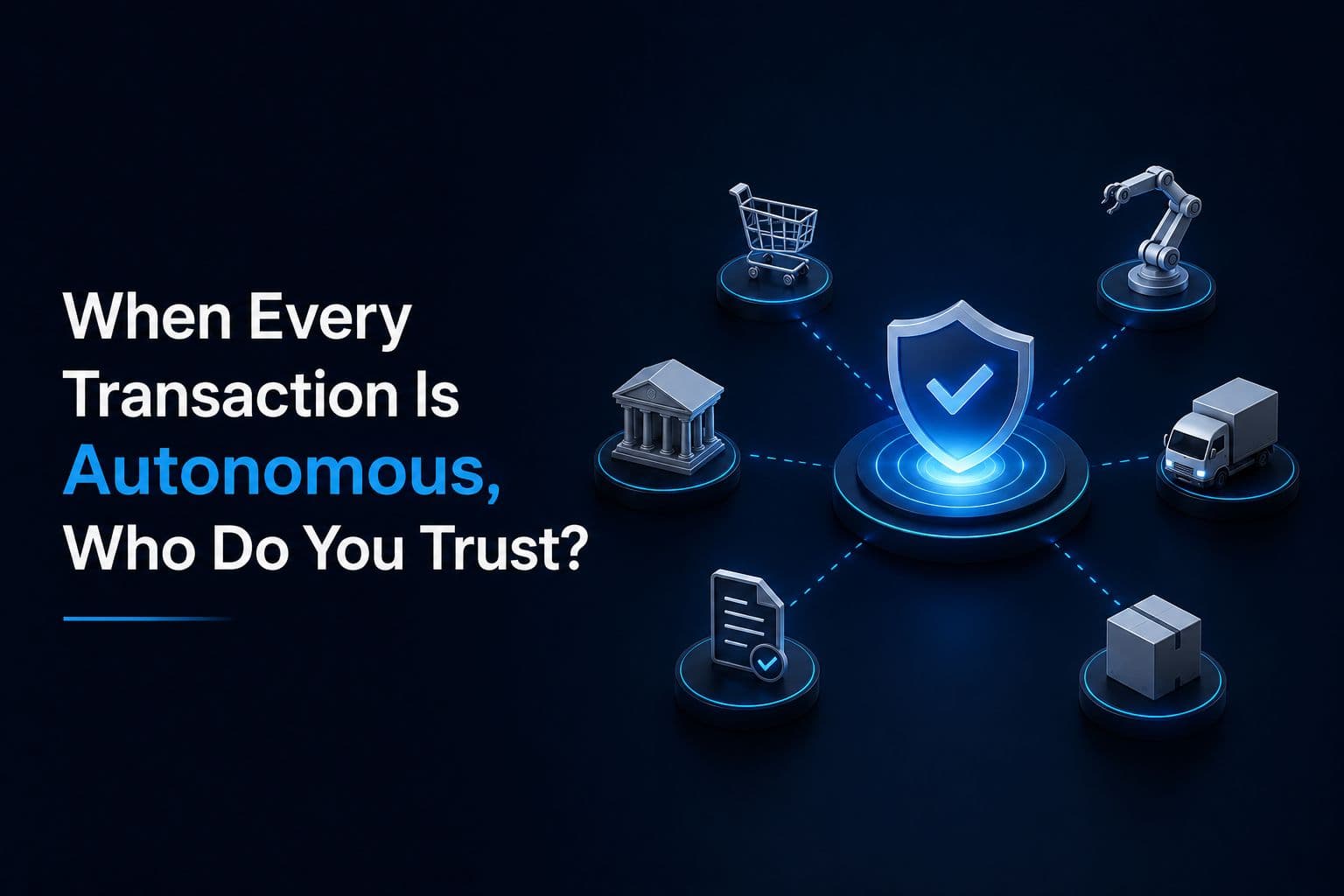
Soon, the parties on both sides of a transaction may be machines acting on their own. The oldest question in commerce, who do you trust, gets a brand-new answer.
Commerce has always managed a basic problem: how do strangers transact safely? We answered it with reputations, intermediaries, contracts, and laws, all designed for humans who can be persuaded, sued, or shamed. Autonomous transactions break every one of those tools, because the parties are machines that none of them were built for.
When an agent buys from an agent, with no human approving either side, trust cannot rest on reputation or recourse. It has to rest on proof, cryptographic, automatic, and instantaneous. The answer to "who do you trust?" becomes "whatever I can verify, right now." Building the infrastructure that supplies that proof is the work of the AI economy.
The Old Tools Don't Fit
Reputation, intermediaries, and legal recourse were built for human parties. Autonomous machines render all three too slow, too coarse, or irrelevant.
A machine cannot be shamed by a bad review in the moment of a microsecond transaction, and legal recourse after the fact is no defense against millions of automated interactions a day. Intermediaries that add human checks cannot keep pace without becoming the bottleneck.
The mechanisms that made human commerce safe simply do not operate at the speed or scale of autonomous transactions. Something native to the machine context is required.
Proof Replaces Reputation
In autonomous commerce, trust is not earned over time. It is proven on contact, or the transaction does not happen.
A machine has no patience for reputation to accrue. It needs, in the instant of interaction, cryptographic proof that the counterparty is who it claims to be, is authorized to transact, and that the terms are intact. Trust collapses from a relationship into a verification.
This is not a downgrade. Proof is stronger than reputation, it cannot be faked by a good story or a slick interface. But it requires infrastructure that can supply it instantly and universally.
Who Sets the Terms of Verification
In a world where trust is proof, whoever provides the verification infrastructure holds extraordinary leverage.
Every autonomous transaction depends on a shared way to verify the parties. The provider of that capability sits at the center of commerce, much as payment networks do today, indispensable, embedded, and defensible.
This is why trust infrastructure is not a feature but a position. The question "who do you trust?" ultimately routes through whoever supplies the proof, and that is a place of enormous strategic value.
Proof Is Only as Good as Its Cryptography
Cryptographic proof that quantum computing can forge is not proof at all.
If autonomous trust rests on cryptographic verification, the durability of that trust is the durability of the cryptography. Quantum-vulnerable primitives turn "proven" into "forgeable," undermining the settlement layer of autonomous commerce.
Conux builds the verification layer to be quantum-resilient, so that proof keeps meaning proof as the cryptographic ground shifts.
Answering the Oldest Question
The new answer to "who do you trust?" is precise: whatever can prove its identity, authority, and integrity, cryptographically and instantly.
That answer scales to a world of autonomous transactions in a way reputation and recourse never could. It is colder than the human version, but it is also harder to fool, and it is the only answer that works at machine speed.
Conux is building the infrastructure that makes that answer available on every transaction, so that when everything is autonomous, trust still has a foundation.
When every transaction is autonomous, trust becomes proof. Conux builds the verification layer that supplies it. Talk to us.