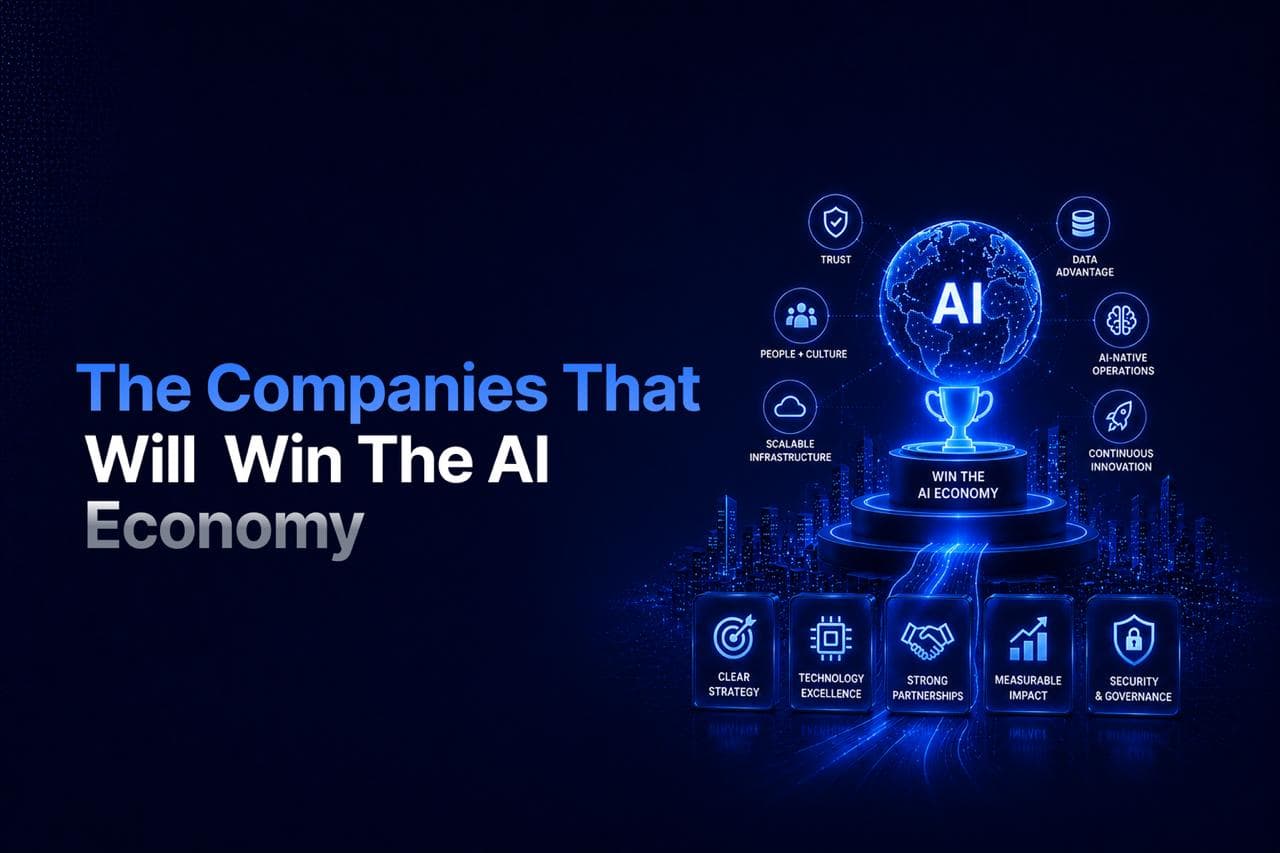
The winners of the AI economy will not be decided by who has the best model. They will be decided by who can be trusted to let machines act.
There is a comforting assumption that the AI economy will be won on model quality, that the smartest system takes the market. History suggests otherwise. Foundational technologies tend to commoditize; the durable advantage moves to whoever controls the layer that makes the technology usable at scale.
For AI, that layer is trust. The constraint on autonomous business is not how capable the agents are. It is whether an organization can safely let them act. The companies that solve that, internally and for others, will compound advantages the rest cannot match.
Capability Commoditizes; Trust Compounds
Models are converging in capability and falling in price. The scarce resource is not intelligence. It is the trust to deploy it autonomously.
When every competitor can access comparable AI, the model stops being the differentiator. What separates the winners is who can put that capability into production without fear, touching real money, real customers, real systems.
That requires trust infrastructure. The company that has it deploys autonomy broadly and safely; the company that lacks it keeps a human in every loop and forfeits the economics of automation.
The Adoption Bottleneck Is Trust
Most enterprises are not blocked from AI by technology. They are blocked by the inability to prove their AI can be trusted to act.
Boards ask the same questions everywhere: if an agent acts wrongly, can we prove what happened and prevent it? Until that answer is yes, autonomy stays confined to low-stakes tasks, and the transformative value stays out of reach.
Solving trust unlocks the high-stakes use cases, the ones that actually move the business. The winners are the firms that cross that line first.
Trust as Operating Leverage
Every increment of verifiable trust converts directly into autonomy, and every increment of autonomy compounds into speed and cost advantage.
An organization that can trust its machines acts faster, decides faster, and operates leaner. Those gains compound: faster cycles fund more automation, which earns more trust, which enables more autonomy. It is a flywheel, and trust is the axle.
Competitors without the trust layer face the opposite. Every expansion of autonomy raises risk they cannot absorb, so they slow down precisely where they need to accelerate.
Why the Foundation Must Be Quantum-Resilient
A trust advantage built on breakable cryptography is a lead with a fuse on it.
The firms building durable trust will build it to survive the quantum transition. Those that cut the corner gain a temporary edge and inherit a forced, expensive rebuild, at the worst possible moment, under regulatory and adversarial pressure.
Winning the AI economy is a long game. The companies that treat quantum resilience as foundational are the ones whose advantage actually lasts.
The Profile of a Winner
The companies that win the AI economy will look less like the smartest and more like the most trustworthy, provably, automatically, and at scale.
They will be the organizations a machine can verify on first contact, that can grant autonomy without fear, and whose trust foundation outlasts the cryptographic shift. That profile is built, not bought, and it starts now.
Conux builds the trust layer that produces this profile, so the companies that adopt it early are positioned to be among the winners, not the ones renting trust from them later.
The winners of the AI economy will be the most trustworthy, provably and at scale. Conux builds that foundation. Let's talk.