The internet was designed for humans. It is quietly becoming an internet of machines talking to machines, and its root of trust was never built for that world.
Most traffic on the modern internet is already non-human: automated services, bots, APIs, and increasingly AI agents. The web's trust model, however, still assumes a human at one end verifying a server at the other. We are running a machine-to-machine internet on a human-to-server trust model, and the seams are showing.
A root of trust is the anchor everything else is verified against. The post-human internet needs a new one, built for non-human identities, designed for machine-speed verification, and resilient to the quantum threat that will break the anchors we use today. This is foundational, and it is overdue.
The Internet Already Went Non-Human
The majority of interactions online no longer involve a person at all, yet our trust infrastructure still assumes one.
Services call services, agents invoke APIs, and automated systems transact continuously beneath the human-facing web. This machine layer has grown enormous, but it inherited a trust model built for people logging into websites.
The mismatch is structural. Verifying a server to a human browser does little to establish trust between two autonomous machines that have never interacted and never will involve a person.
What a Root of Trust Does
A root of trust is the foundational anchor every other verification chains back to. If it is wrong or weak, everything built on it is too.
All trust systems bottom out in a root: a key, an authority, an anchor assumed to be valid. From it, chains of verification extend outward. The integrity of the whole system depends entirely on the integrity of that root.
Today's roots of trust were established for a human-centric web and secured with classical cryptography. Both assumptions are failing at once, wrong population, expiring security.
Designing a Root for Machines
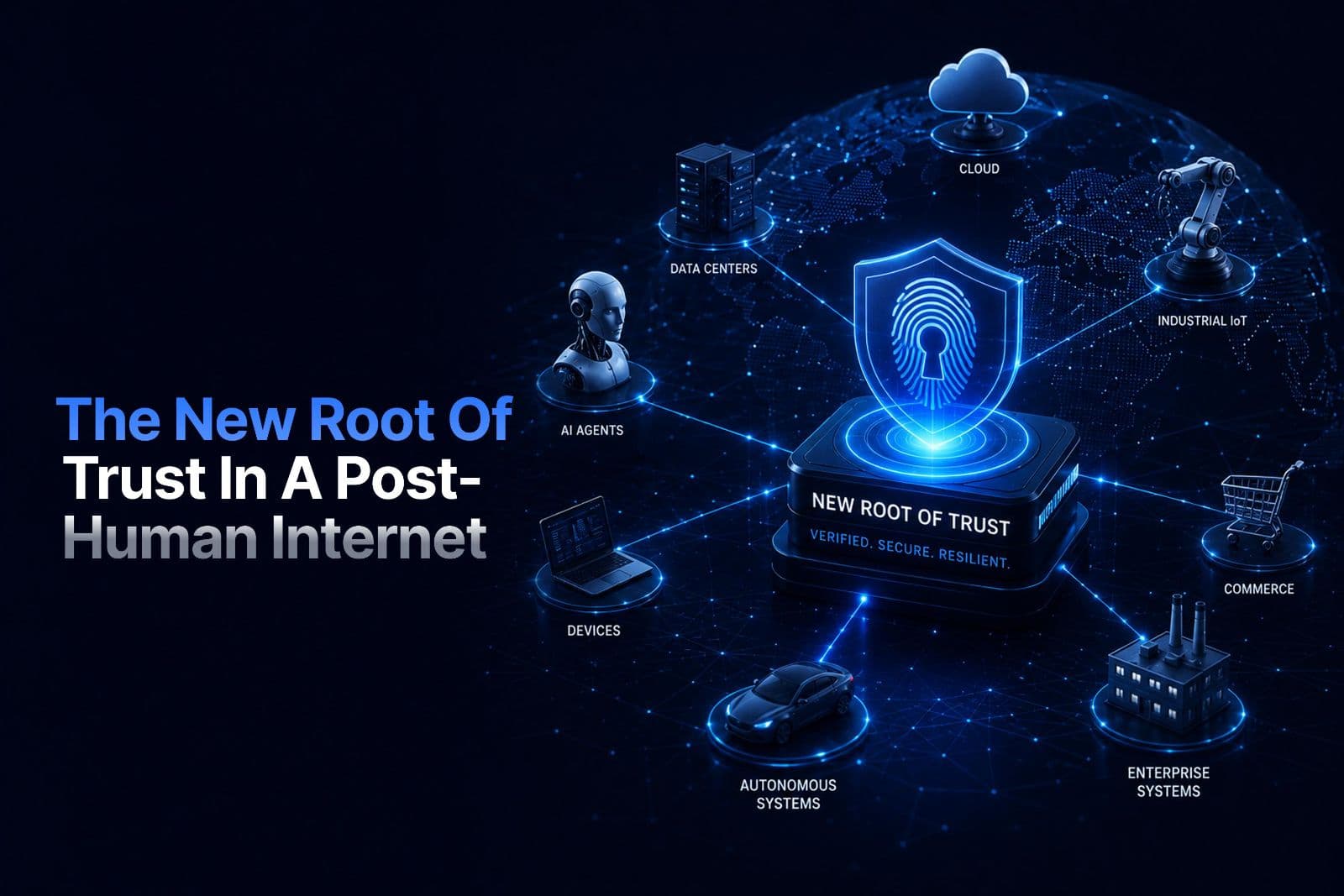
A root of trust for the post-human internet must anchor non-human identities and verify them automatically, at machine speed and machine scale.
The new root cannot depend on human judgment anywhere in the loop. It must issue and verify identities for machines, support authority and integrity checks automatically, and operate at the volume of an internet where machines vastly outnumber people.
This is not a tweak to the existing model. It is a purpose-built foundation for a different kind of network, one where the participants are overwhelmingly non-human.
Why the New Root Must Be Quantum-Resilient
Rebuilding the root of trust on cryptography quantum computing will break would be a generational mistake.
If we are going to establish a new root of trust for the machine internet, it has to be built on cryptography that survives the quantum era. A root anchored in quantum-vulnerable primitives would be obsolete before it was fully adopted.
Conux builds roots of trust that are quantum-resilient from the anchor outward, so the foundation of the post-human internet does not have to be rebuilt the moment it matures.
Foundational, and Being Decided Now
Roots of trust are generational infrastructure. The one for the machine internet is being shaped in this window.
The roots of trust that secured the human web held for decades and shaped everything above them. The root for the post-human internet will be just as consequential and just as durable. The decisions being made now will echo for a long time.
Conux is building for that foundation, a quantum-resilient root of trust for an internet where the actors are machines. It is the deepest layer of the trust infrastructure the AI economy requires.
The post-human internet needs a new, quantum-resilient root of trust. Conux is building it, start the conversation.