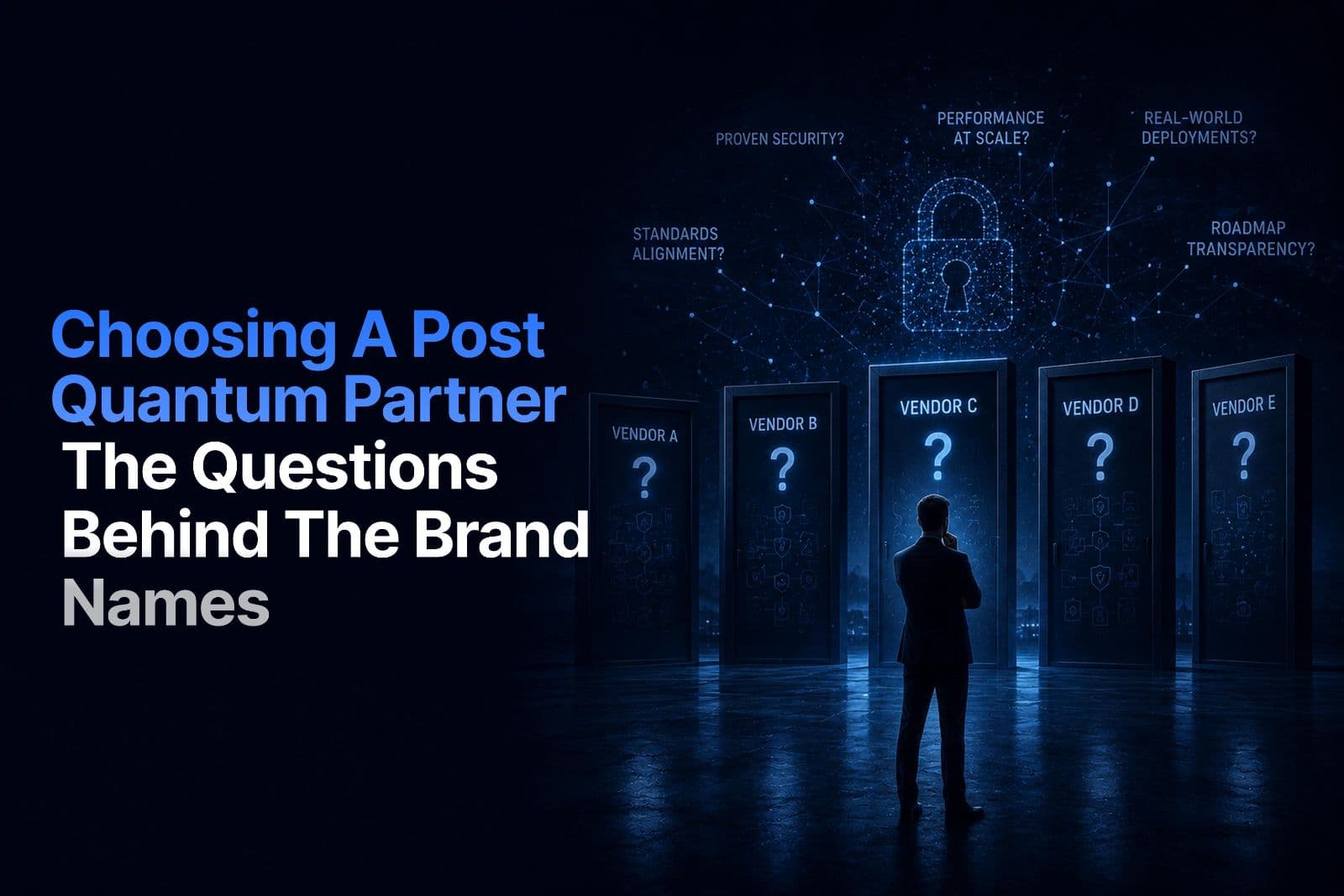
When a category is new, buyers reach for the names they've heard. In post-quantum security, that often means a shortlist anchored by a few well-funded firms (SandboxAQ among them) and a quiet assumption that the recognizable name is the safe choice. So the hunt for SandboxAQ alternatives usually begins as a list of logos rather than a list of requirements.
It might be. But recognition isn't a selection criterion. If you are weighing SandboxAQ alternatives, the useful exercise isn't comparing logos. It's knowing which questions actually separate a vendor that secures your whole enterprise from one that secures a slice of it.
"Recognition isn't a selection criterion. The right partner is the one whose coverage maps to your exposure, not the one with the most familiar logo."
The Question Most Shortlists Skip
Most vendor comparisons start with features. The better starting point is scope: does this partner coordinate quantum-safe security across your whole environment, or does it protect one layer (a chip, an algorithm, a key store) and leave the rest to you?
This matters because fragmentation is where exposure hides. An enterprise can adopt a quantum-safe algorithm in one system and still be wide open everywhere that algorithm wasn't applied. The hard problem isn't any single component. It's coordination across all of them. That is the lens that makes evaluating SandboxAQ alternatives a strategic exercise rather than a feature bake-off.
Four Questions That Reveal More Than a Feature List
Can it see our entire cryptographic estate? You cannot migrate what you cannot inventory. Visibility across cloud, applications, networks, and partners is the foundation everything else rests on.
Can it change algorithms without breaking the business? Standards will keep evolving. NIST only finalized its first post-quantum set in 2024 and more will follow. A partner should let you swap algorithms without re-architecting infrastructure each time, a capability known as crypto-agility.
Does it protect AI systems specifically? Your AI deployments are now among your most sensitive data flows. A partner that treats them as an afterthought is securing yesterday's architecture.
Can it produce compliance evidence on demand? When CNSA 2.0 (with milestones in 2027), FIPS 140-3, or HIPAA reviews arrive, you'll need defensible reporting, not a scramble.
Comparing SandboxAQ Alternatives Without Getting Lost in Jargon
The trap when comparing SandboxAQ alternatives is letting each vendor define the scoreboard with its own terminology. Hold every option to the same four questions above, in your language, mapped to your environment. The vendor that answers clearly and specifically is telling you something the brochure can't.
A large, well-capitalized vendor signals staying power, and that's worth something. But size often correlates with a specialized focus: deep in one layer, narrow across the estate. The right partner is the one whose coverage maps to your actual risk surface, not the one with the most familiar name in the room.
Why "Big Name" and "Right Fit" Aren't the Same Thing
By most industry estimates, the overwhelming majority of enterprises (cited by CONUX at roughly 97%) are not yet prepared for quantum-safe standards. That means almost everyone is buying for the first time, with no track record to lean on. In that environment, brand familiarity is doing a lot of unearned work.
Choosing on coverage, agility, AI-awareness, and compliance evidence gives you a decision you can defend on its merits. Choosing on recognition alone gives you a name to point at. Those are not the same thing when the room goes quiet and someone asks why.
Making the Decision Defensible
A post-quantum partner decision will eventually be reviewed: by a board, an auditor, or a major client doing due diligence. Document the choice against objective criteria so it rests on demonstrated fit with your risk surface.
That is the real value of treating SandboxAQ alternatives as a structured evaluation rather than a popularity contest: when the review comes, your reasoning is already written down.
A Simple Scorecard for SandboxAQ Alternatives
Turn the four questions into a one-page scorecard and score every vendor identically.
Coverage: how much of your estate, from cloud to AI systems, does it actually secure?
Agility: can you change algorithms later without re-architecting?
AI-awareness: does it protect modern, AI-driven data flows?
Compliance: can it produce CNSA 2.0, FIPS 140-3, and HIPAA evidence on demand?
Score each from one to five, in your own words, with notes on what the vendor actually demonstrated rather than what it claimed. When you compare SandboxAQ alternatives this way, the differences that matter rise to the top and the marketing falls away.
The Mistake That Outlives the Purchase
The costliest evaluation error isn't picking the wrong feature. It's picking a partner whose scope is narrower than your exposure, then discovering the gap during an audit or a breach. A point solution that secures one layer can leave you technically compliant in one place and wide open everywhere else.
This is why the search for SandboxAQ alternatives should begin from your risk surface, not from a vendor's feature list. The right question is never "what does this product do?" but "what does our enterprise need secured, and how much of that does this partner actually cover?"
Answer that honestly and the shortlist tends to reorder itself, often away from the most familiar name and toward the one whose coverage genuinely fits.
After the Decision: Make It Hold Up
Choosing among SandboxAQ alternatives is only half the job. The other half is ensuring the decision survives contact with reality. That means writing down the criteria, the scores, and the evidence at the time you decide, not reconstructing them later when an auditor or board asks why.
A documented evaluation does something subtle but powerful: it shifts the basis of the decision from personality and reputation to demonstrated fit. When the review comes, you are not defending a hunch about a familiar brand. You are presenting a scored comparison tied to your actual risk surface.
That discipline is what separates a defensible enterprise decision from an expensive guess, and it is entirely within your control regardless of which vendor you ultimately choose. In a market this new, a decision you can explain clearly is worth far more than one that merely sounded impressive in the room, because the explanation is the part that survives the audit, the board review, and the client's due diligence.