For all of commercial history, the customer has been a person. The next customer is an algorithm -- and it will reshape everything from checkout to trust.
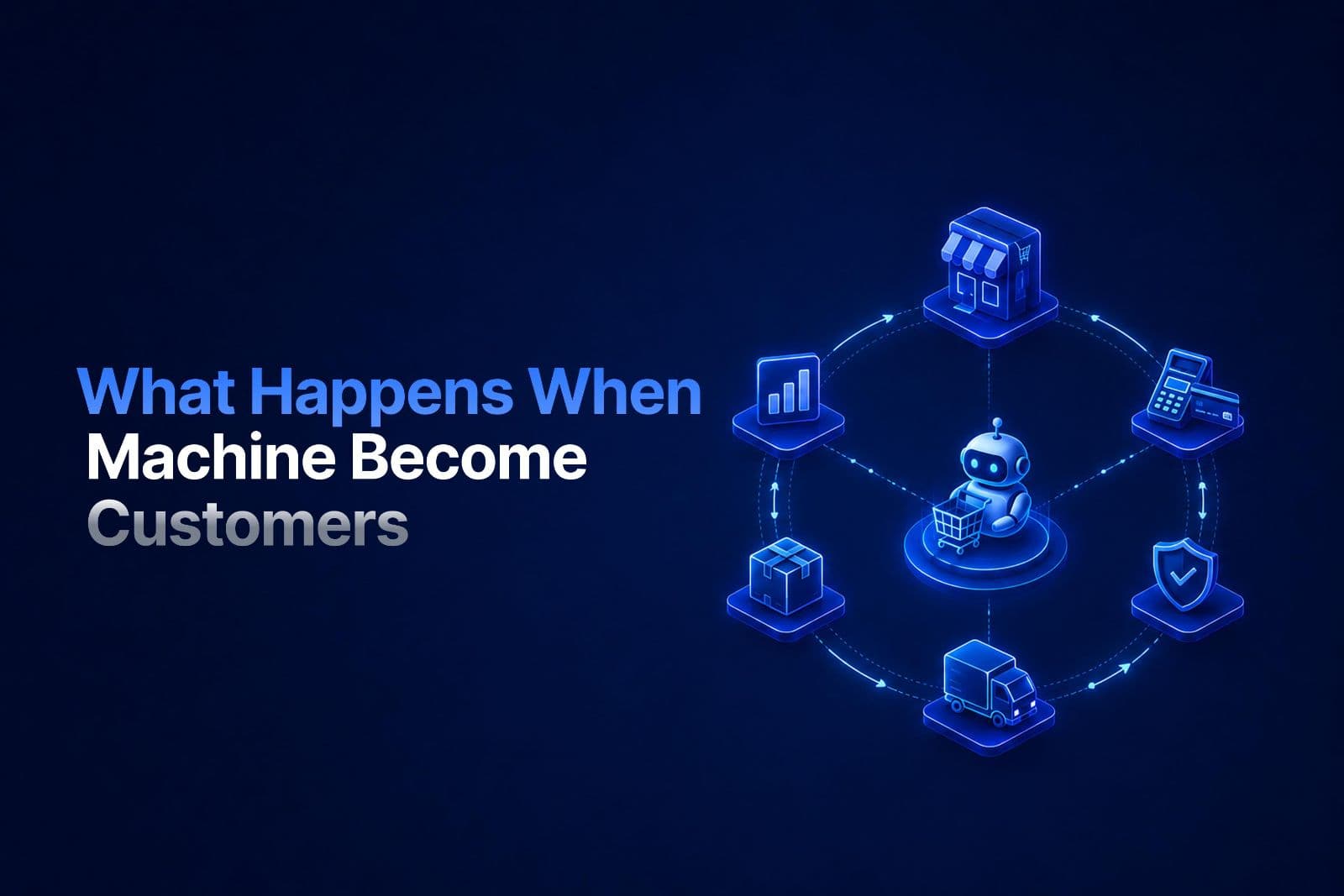
Picture the near future: your AI agent compares suppliers, negotiates a price, places the order, and pays -- all without you watching. On the other side, a supplier's agent verifies the buyer, approves the terms, and fulfills. Two machines have just completed a transaction with no human in the loop.
When machines become customers, the assumptions baked into commerce for centuries stop holding. Marketing, pricing, fraud, and above all trust were designed for human buyers. The AI economy is not just automation of old commerce. It is a new economy with a new kind of participant -- and it needs new infrastructure to function.
The Buyer Has Changed
A machine customer does not browse, get persuaded, or forgive a bad experience. It evaluates, verifies, and transacts on logic -- at a speed and scale no human market has ever seen.
Agentic buyers will compare thousands of options instantly, weigh terms without emotion, and switch suppliers the moment a better verified offer appears. The soft levers of human commerce lose their grip; the hard levers -- provable identity, verifiable terms, machine-readable trust -- become everything.
This rewards a very specific capability: being trustworthy in a way a machine can verify automatically. Brands that cannot prove themselves to another machine simply will not be transacted with.
Trust Becomes the Transaction
When two agents transact, the deal happens only if each can verify the other's identity, authority, and integrity. Trust is no longer a backdrop to the sale. It is the gate.
A human buyer might proceed on reputation or a polished website. A machine buyer requires cryptographic proof: that the counterparty is who it claims to be, is authorized to make the deal, and that the terms have not been altered in transit.
Without that proof, the transaction does not happen -- or worse, happens with an impostor. The infrastructure that supplies this proof is the same trust layer the AI economy depends on everywhere else.
Fraud at Machine Speed
Every capability that lets legitimate agents transact instantly also lets fraudulent ones attack instantly. Machine-speed commerce invites machine-speed fraud.
If agents can buy and sell autonomously, malicious agents can defraud autonomously -- impersonating buyers, spoofing suppliers, and exploiting trust gaps faster than any human fraud team can respond. The defense cannot be slower than the attack.
Only automated, cryptographic trust operates at the same tempo as the threat. Manual review is structurally too slow for an economy where the customer is an algorithm.
Why This Depends on Durable Cryptography
An economy of machine customers is an economy of cryptographic proofs -- and those proofs must outlast the quantum transition to be worth anything.
Every machine-to-machine transaction leans on cryptographic identity and signatures. If that cryptography becomes forgeable, the entire settlement layer of the AI economy becomes untrustworthy. The risk is not theoretical; it is the foundation cracking.
Building the machine economy on quantum-resilient trust is the difference between infrastructure that compounds value and infrastructure that quietly accumulates risk.
Positioning for a Machine-First Market
The winners of the AI economy will be the organizations a machine can trust on first contact -- instantly, cryptographically, and without a human vouching for them.
That capability is not a marketing posture. It is infrastructure: verifiable identity, provable authority, tamper-evident integrity, all quantum-resilient. The companies that build it early become the default counterparties of the machine economy.
Conux is building the trust layer that makes an enterprise verifiable to the machines that will increasingly be its customers. When machines become customers, trust is the market.
When machines become customers, trust becomes the market. Conux builds the infrastructure that makes your enterprise verifiable to them.