Zero-trust assumes nothing and verifies everything. But almost every zero-trust architecture quietly trusts one thing without question: the cryptography underneath it.
Zero-trust has become the dominant security model for good reason. 'Never trust, always verify' is the right posture for a world without a perimeter. Organizations have invested heavily in verifying every user, device, and request. But there is an assumption buried beneath the whole model that almost no one questions.
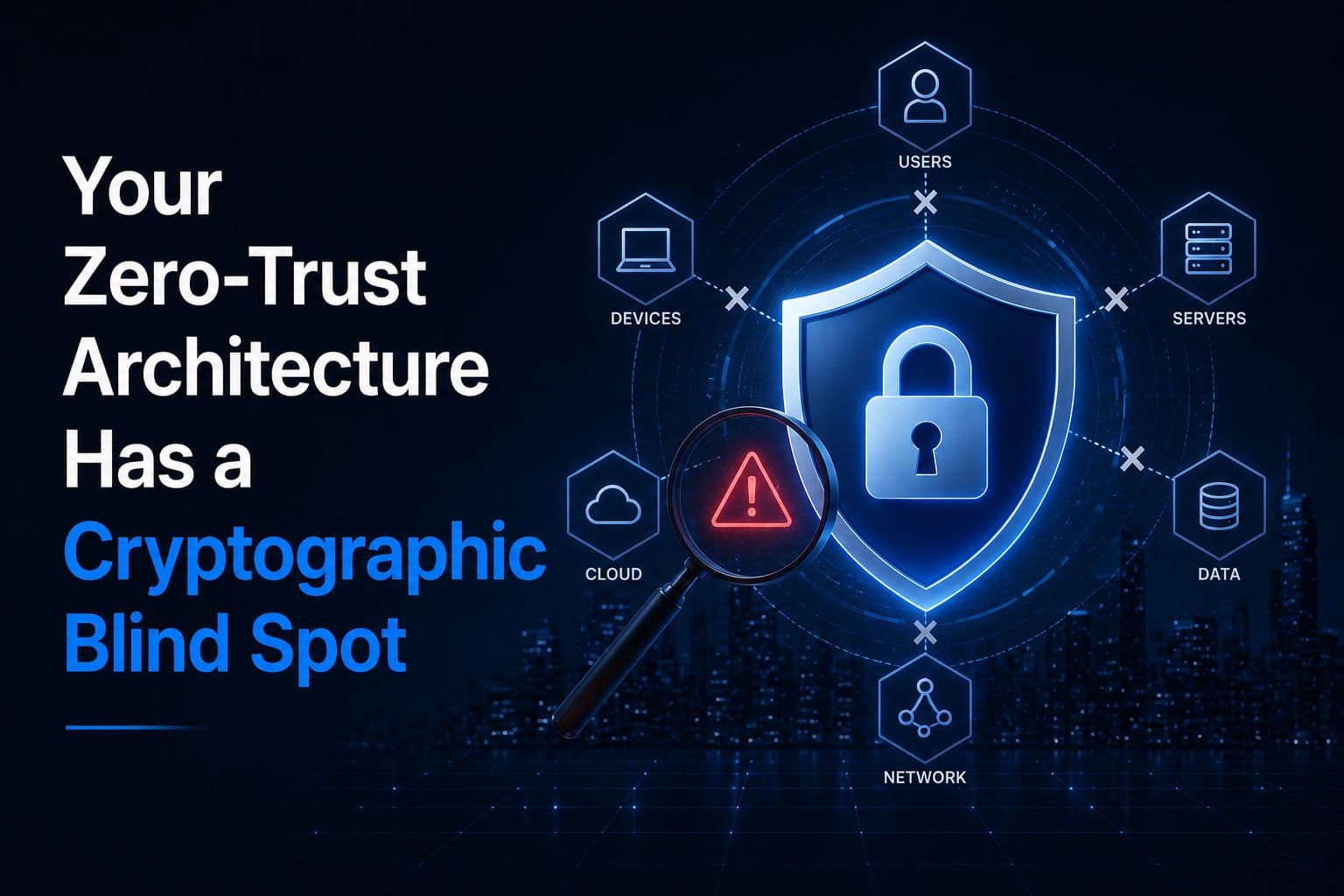
Every zero-trust verification (every authentication, every encrypted session, every signed token) relies on cryptography. Zero-trust verifies the actors but implicitly trusts the cryptographic primitives doing the verifying. When those primitives are threatened by quantum computing, the foundation of zero-trust is exactly the thing it never thought to verify. That is the blind spot.
The Assumption Underneath Zero-Trust
Zero-trust verifies identities and requests by trusting that the cryptography performing the verification cannot be broken.
Authentication tokens, mutual TLS, signed assertions, the mechanisms zero-trust uses to verify everything, are themselves cryptographic. The model rigorously distrusts actors while implicitly, completely trusting the cryptographic tools it uses to evaluate them.
That trust is reasonable only as long as the cryptography holds. The quantum transition is precisely the event that makes it stop holding.
Why Quantum Breaks the Foundation, Not the Walls
Quantum computing does not bypass zero-trust controls. It undermines the cryptography those controls are built from.
If the cryptographic primitives behind authentication and encryption become forgeable, an attacker does not need to defeat zero-trust head-on. They can forge the very proofs zero-trust relies on to grant access, impersonating verified identities and presenting valid-looking credentials.
The architecture remains standing, but its verifications can no longer be believed. Verifying everything is meaningless if the verification itself can be faked.
Why This Blind Spot Persists
Zero-trust programs focus on policy, identity, and segmentation, and rarely examine the durability of the cryptography beneath them.
Most zero-trust initiatives are organized around access policy and identity governance. The cryptographic layer is treated as a solved, stable substrate. That framing made sense before quantum, and it is exactly why the blind spot goes unnoticed.
The result is mature zero-trust architectures resting on cryptographic foundations no one in the program is responsible for future-proofing.
Closing the Blind Spot
A complete zero-trust posture extends its 'verify everything' principle to the cryptography itself, including its resilience to quantum attack.
Truly zero-trust means not exempting the cryptographic foundation from scrutiny. That requires inventorying the cryptography behind every control, assessing its quantum exposure, and ensuring it can be upgraded, applying agility to the layer zero-trust depends on most.
Conux closes this blind spot by making the cryptographic foundation of zero-trust quantum-resilient and adaptable, so 'always verify' holds all the way down.
Zero-Trust That Holds All the Way Down
A zero-trust architecture is only as trustworthy as the cryptography it never thought to question.
Extending zero-trust principles to the cryptographic layer turns a hidden dependency into a governed one. It is the difference between an architecture that verifies everything except its own foundation and one that is genuinely trustworthy end to end.
Conux gives zero-trust the quantum-resilient cryptographic base it implicitly assumes, making the model live up to its own promise.
Zero-trust is only as strong as the cryptography it never questions. Conux makes that foundation quantum-resilient: let's talk.