For most of computing history, identity meant people. The fastest-growing population on your network is no longer human -- and it has no identity at all.
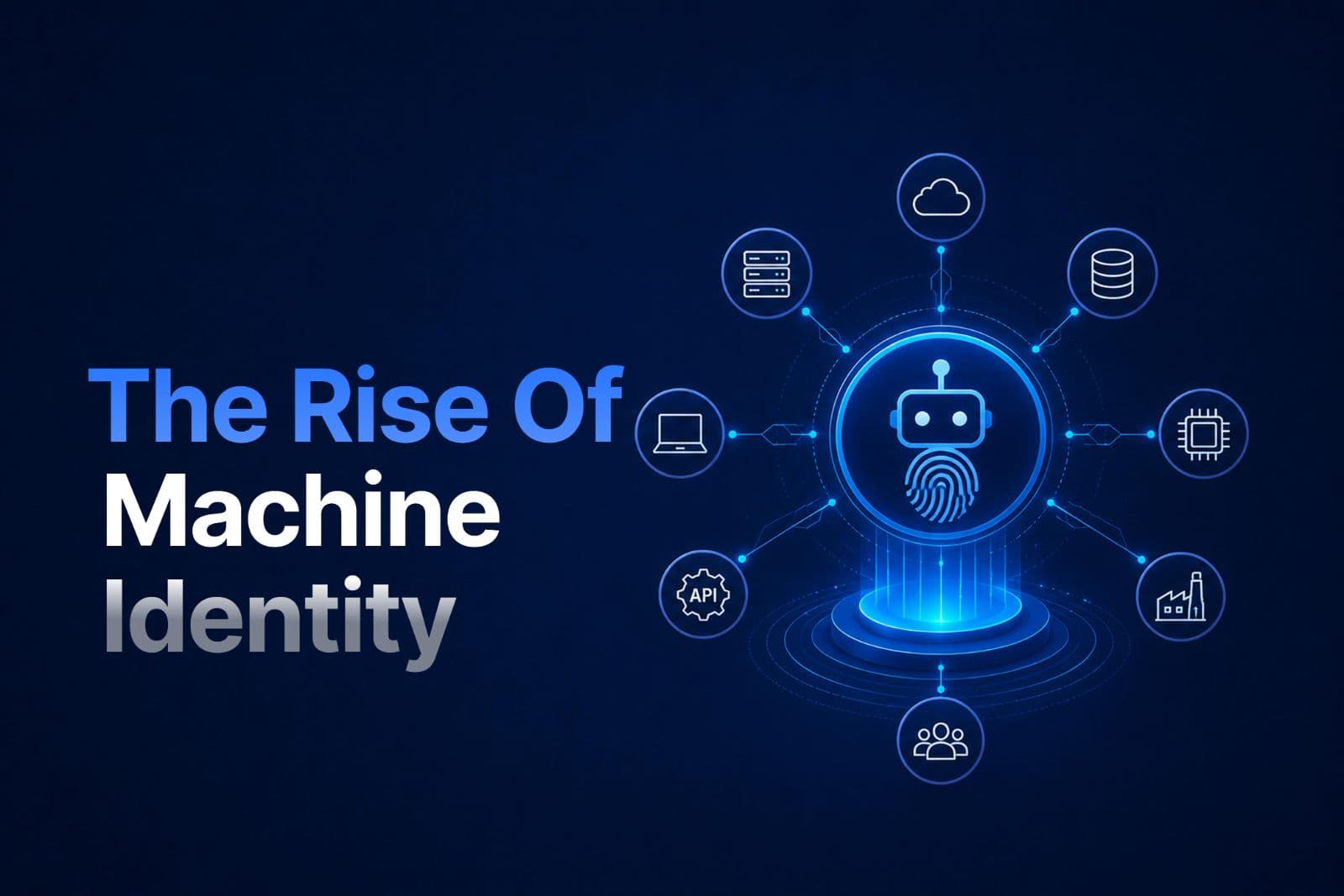
There are already more machine identities than human ones inside the modern enterprise -- by a wide margin. Service accounts, workloads, containers, APIs, bots, and now AI agents each need to authenticate, access resources, and act. Most do so with credentials that are sprawling, unmanaged, and invisible.
Machine identity is becoming the defining security and trust challenge of the decade. Not because it is new, but because AI is about to multiply it by orders of magnitude -- and the tools built for human identity were never designed to govern a population that grows itself.
The Population Nobody Counted
In most enterprises, machine identities already outnumber human identities many times over -- and unlike employees, they are created faster than anyone can track.
Every microservice, automation script, and cloud workload carries credentials. They authenticate to databases, call APIs, and access secrets, often with privileges no human would be granted. Yet most organizations cannot produce an accurate inventory of these identities or the keys they hold.
This is the quiet crisis underneath digital transformation: we automated everything and gave each piece of automation an identity, then never built a system to govern them.
Why AI Agents Change the Math
An AI agent is a machine identity that can create more machine identities -- turning a management problem into a compounding one.
Traditional workloads are static; you deploy them and their identity persists. AI agents are dynamic. They spin up sub-tasks, call other agents, and request new access in pursuit of goals. Each interaction is a new identity event, generated at machine speed without human approval.
Govern human identity badly and you have a backlog. Govern machine identity badly in the agentic era and you have an ungoverned, self-expanding population with access to your most critical systems.
Why Human Identity Tools Don't Transfer
Human identity assumes a person who can be onboarded, trained, and held accountable. Machine identity assumes none of that -- and needs a different model entirely.
You cannot send a workload to security awareness training or call a service account into a review. Machine identity must be governed automatically: provisioned with least privilege, rotated continuously, verified cryptographically, and revoked the instant it misbehaves.
Bolting machines onto a human-centric identity system produces exactly what enterprises see today -- stale credentials, over-privileged accounts, and no clear owner when something goes wrong.
The Cryptographic Core
At its foundation, machine identity is a cryptographic problem -- and that makes it a quantum problem.
Machine identity is proven with keys, certificates, and signatures. The strength of a machine's identity is the strength of its cryptography. When quantum computing weakens those primitives, every machine identity built on them becomes forgeable.
This is why machine identity cannot be solved in isolation from the post-quantum transition. The two are the same fight: making sure that when a machine proves who it is, that proof actually holds.
From Liability to Infrastructure
Machine identity, governed well, stops being a sprawling liability and becomes the backbone of trustworthy automation.
When every machine has a verifiable, least-privileged, quantum-resilient identity, automation becomes something you can trust at scale rather than something you hope holds together. That is the precondition for the AI economy -- not a nice-to-have.
Conux treats machine identity as foundational infrastructure for that economy, governed by the same trust layer that will carry enterprises through the quantum transition.
Machine identity is the backbone of trustworthy automation. See how Conux governs it for the AI and post-quantum era.