There's a sentence that ends a lot of security conversations prematurely: "We use AES-256 encryption." It sounds like a complete answer. It's treated like a finish line.
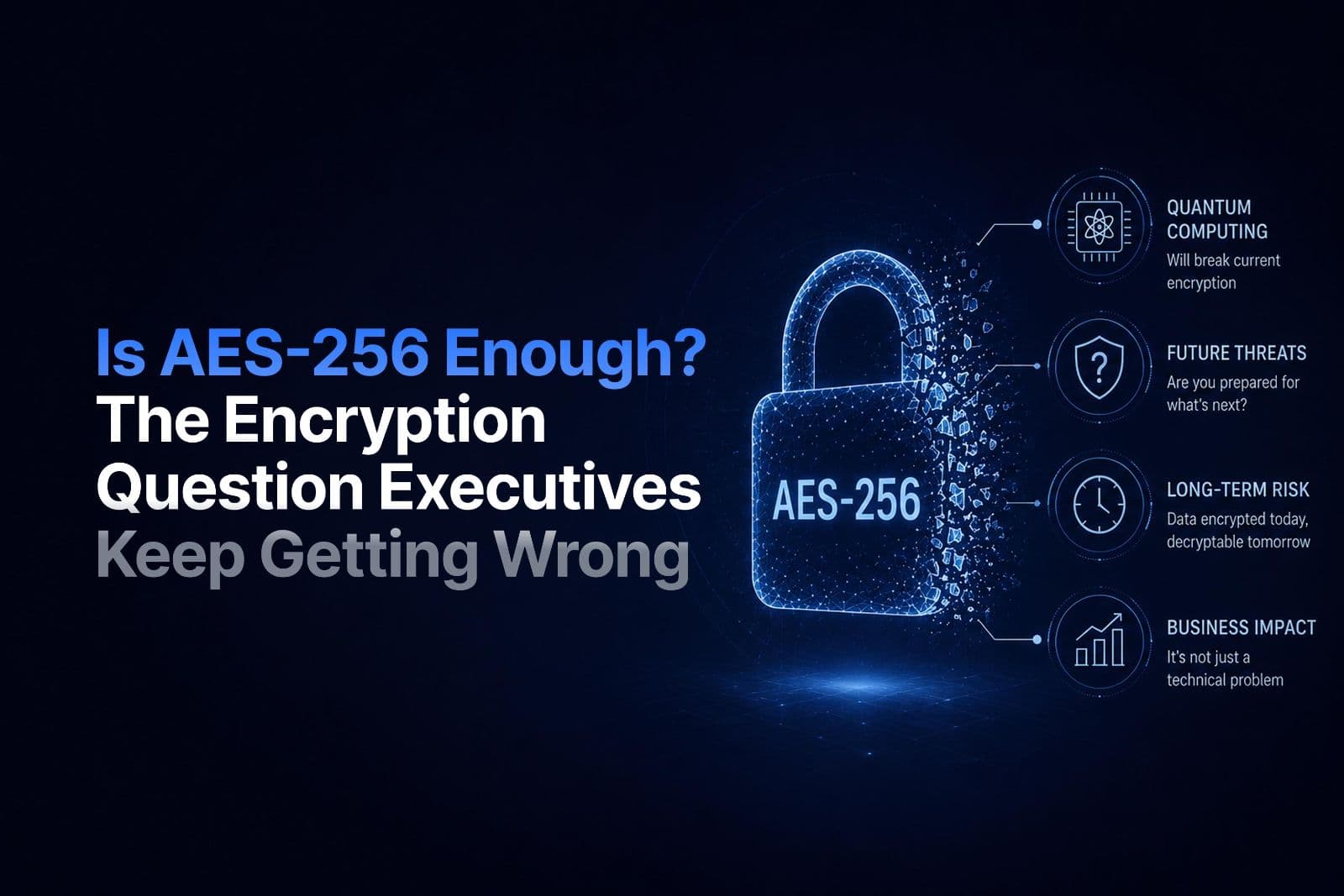
AES-256 encryption is a genuinely strong algorithm. But "we use AES-256 encryption" answers a narrower question than the one being asked, and the gap between those two questions is exactly where quantum risk lives.
"We use AES-256" means your data sits behind a strong lock, with the key exchanged through a door quantum computing is built to open."
What AES-256 Encryption Actually Protects
AES-256 encryption is symmetric encryption: it scrambles data using a key both sides already share. It's fast, trusted, and (importantly) holds up comparatively well even against quantum computers. If AES-256 encryption were the whole story, the quantum conversation would be far less urgent.
But AES-256 encryption has a precondition hiding in plain sight: both sides must already share the key. The question of how that key got there safely is a completely different piece of math, and a far more fragile one.
The Part That Isn't Quantum-Safe
Getting a shared key across the open internet relies on asymmetric cryptography: RSA, elliptic curve, Diffie-Hellman. That is the part a quantum computer breaks. And it is the part that makes AES-256 encryption usable at all in a connected enterprise.
So the honest version of "we use AES-256 encryption" is: "our data is scrambled with a strong lock, and the key to that lock is exchanged using a method quantum computing is expected to break." The strong algorithm is protecting data behind a vulnerable door. When NIST finalized its post-quantum standards in 2024, it was precisely this key-exchange and signature layer it set out to replace.
Why Smart Teams Still Get AES-256 Encryption Wrong
This isn't negligence. It's a reasonable shorthand that aged badly. For years, naming a strong symmetric cipher like AES-256 encryption was a fair proxy for "we take encryption seriously." The quantum shift quietly invalidated the shorthand without changing the vocabulary people use.
It's the same pattern leaders have seen with AI: a tool that was perfectly adequate yesterday becomes a liability the moment the surrounding landscape changes faster than the assumptions about it.
What the Threat Timeline Says
The risk isn't hypothetical or distant. Adversaries already practice "harvest now, decrypt later," collecting encrypted data today to decrypt after quantum computers mature. The NSA's CNSA 2.0 guidance sets adoption milestones for quantum-resistant cryptography in 2027, and by most industry estimates roughly 97% of enterprise systems are not yet prepared.
Against that backdrop, relying on AES-256 encryption alone isn't a strategy. It's a comfortable assumption with a deadline attached.
The Better Question to Ask
Replace "do we use strong encryption?" with "how do we exchange and manage keys, and is that method quantum-resistant?" That single reframing moves the conversation from a comfortable yes to a productive audit of where AES-256 encryption ends and your real exposure begins.
AES-256 encryption isn't the problem. Assuming it's the whole answer is.
What the Quantum Threat Actually Targets
It helps to be precise about what is and isn't at risk. A quantum computer running Shor's algorithm efficiently breaks the asymmetric methods (RSA, Diffie-Hellman, elliptic curve) that establish secure connections. Symmetric ciphers face a different, far milder attack (Grover's algorithm) that effectively halves their strength, which is why a 256-bit key remains comfortably out of reach.
So the threat is surgical, not total. It removes the mechanism that lets two parties agree on a secret key over an open network. Everything that depends on that mechanism (which is almost everything) inherits the exposure, even when the data itself is wrapped in a strong cipher.
From Comfortable Answer to Real Audit
The path forward isn't to abandon strong ciphers. It's to extend the same seriousness to the part that's actually vulnerable. That means inventorying where asymmetric cryptography is used, identifying which protected data must stay confidential for years, and replacing the exposed key-exchange and signature methods with post-quantum standards, often in a hybrid configuration during the transition.
None of this requires halting the business. It requires visibility and sequencing: see what you have, rank it by sensitivity and longevity, and migrate the highest-risk paths first against the 2027 timeline.
The leaders who do this well stop treating encryption as a checkbox and start treating it as a living posture, one that has to keep pace with a threat landscape now moving at the speed of both AI and quantum investment.
Building a Posture That Outlasts the Next Standard
The deeper lesson sits above any single algorithm. Cryptography is not a product you install once and forget. It is a posture you maintain as the threat landscape moves. The methods considered unbreakable a decade ago are the ones now being deprecated, and the standards finalized today will themselves be revised.
That reality argues for crypto-agility: the organizational and technical ability to change cryptographic methods repeatedly without re-engineering the business each time. An enterprise with crypto-agility treats a new standard as a configuration change, not a crisis. An enterprise without it treats every shift as a fresh, painful migration.
Practically, building that posture means three things: continuous visibility into what cryptography you run and where, a clear owner accountable for the whole estate, and a migration capability that can be invoked on demand rather than assembled under pressure. Get those in place and the question of whether any one cipher is "enough" stops being frightening, because you can always move to the next one before it matters.
This is the shift from thinking about encryption as a wall to thinking about it as a living system, one that is monitored, owned, and built to adapt. It is also the difference between organizations that scramble when a standard changes and those that simply adjust and move on. That adaptability, not the strength of any single cipher, is the real measure of whether an enterprise is ready for what comes after the next standard, and the one after that. It is the quiet capability that separates the genuinely prepared from the merely compliant.