Imagine it's 2031.
A large financial institution has spent the better part of the previous decade building what its security team and board rightfully consider a model identity security program. Behavioral biometrics. Continuous AI-driven verification that monitors every session for anomalies. Passwordless authentication backed by hardware tokens. A zero trust architecture that verifies every request, from every user, for every resource, every time.
It is, by every reasonable measure, the most sophisticated identity security stack the organization has ever had.
And then something unexpected happens.
A fraudulent transaction authorization moves through the system. Not because someone defeated the behavioral analytics. Not because someone spoofed the biometrics. Not because someone broke the zero trust policy engine.
Because someone forged a digital certificate — the kind that your AI verification trusts at the foundation, below the layer where behavioral analytics operate. A certificate that passed every cryptographic check because the mathematics protecting certificate signatures had been broken by a quantum computing capability that, by 2031, several nation-states had quietly achieved.
The AI saw a valid certificate. It had no reason to question it. Nobody had told the AI that "valid certificate" no longer meant what it used to mean.
This scenario isn't inevitable. But it is the precise future that AI identity verification built without a quantum-safe foundation is building toward.
The Category We're Creating — And Why It Matters
There is a new category of enterprise security emerging. Call it quantum-resilient intelligent identity. It's the convergence of two capabilities that have historically been separate programs:
AI-driven identity verification — the application of machine learning to authentication, turning a point-in-time credential check into a continuous, multi-signal, risk-adjusted process.
Quantum-safe cryptographic infrastructure — the replacement of the mathematical foundations that identity verification depends on with a new generation of algorithms that quantum computing cannot break.
Separately, each of these is valuable. Together, they represent the complete answer to the identity security problem of the next decade. Apart, they each have a critical gap: AI identity verification without quantum-safe foundations is sophisticated analysis built on brittle trust; quantum-safe cryptography without AI-driven verification is secure plumbing without the intelligence to use it well.
The enterprises building category leadership in security — the ones that will be recognized as the trusted infrastructure of the digital economy — are the ones building both, together, now.
What AI Identity Verification Actually Gets Right
The case for AI-driven identity verification is real and strong. Let's be clear about what it solves before we address what it doesn't.
The password era created a security model based on a shared secret: if you know the password, you must be who you say you are. That model collapsed under the weight of credential theft, phishing, and the simple fact that people reuse passwords across every service they've ever touched.
AI identity verification replaces the shared secret model with a continuous confidence model. Instead of asking "do you know the password?" it asks: "does everything about this session — your typing patterns, your location, your device, your behavior, your timing, your risk profile — look like you?"
That shift is genuinely significant. It catches compromised credentials when the person using them doesn't behave like the legitimate user. It detects account takeover in progress, not after the fact. It creates an authentication experience that improves over time as the AI builds a richer model of each user's normal behavior.
This is the future of enterprise authentication, and it is already becoming the present for leading organizations.
The question is what the AI is trusting underneath all that intelligent analysis.
The Trust Chain That AI Verification Relies On (And Cannot Verify)
Every AI identity verification system, no matter how sophisticated, operates within a trust hierarchy that it accepts as given. At the bottom of that hierarchy are cryptographic proofs: digital certificates, signed tokens, and authenticated key exchanges that prove identities are what they claim to be.
The AI doesn't verify these cryptographic proofs from first principles. It can't — the mathematics is not the AI's domain. It trusts the cryptographic layer the same way you trust that your bank's website is really your bank: not by verifying the cryptographic math yourself, but by trusting that the certificate validation system did its job.
When quantum computing makes that certificate validation system forgeable — when the mathematics protecting digital signatures becomes solvable — the AI verification system receives a fraudulent credential and has no mechanism to know it's fraudulent. It was built to trust valid certificates. The certificate appears valid. The AI proceeds accordingly.
This is not a criticism of AI identity verification. It is a description of the architectural dependency that quantum secure authentication addresses.
The AI layer is your intelligence. The cryptographic layer is your foundation. You need both to be sound.
The Moment the Two Problems Converge
Here is the development that makes this conversation urgent in a way it wasn't two years ago.
AI systems are becoming enterprise operational infrastructure. Not just for security — for decision-making, data analysis, communications management, and automated process execution. Enterprise AI systems access sensitive data, make consequential decisions, and generate high-volume communication streams.
Those communication streams are being harvested for future quantum decryption right now.
The intelligence that an adversary gains from retroactively decrypting AI system communications from the next few years is not just data. It is decision logic. It is behavioral patterns. It is the operational understanding of how your AI systems work, what inputs they respond to, what patterns they trust.
An adversary with that understanding, in 2031, doesn't need to break your AI's authentication to manipulate your AI. They have a detailed map of how it makes decisions, built from years of harvested and decrypted operational data.
This is the convergence risk — AI capability growing at the same time as quantum threats to the cryptographic infrastructure those AI systems depend on, with a harvest window already open. The organizations that implement quantum-safe foundations for their AI infrastructure now are closing that window. The ones that don't are building the adversary's playbook for the next decade.
Building the Right Architecture: What It Looks Like in Practice
The practical work of building quantum-resilient AI identity verification doesn't require starting over. It requires addressing the foundation while the structure continues to operate.
The certificate layer. Every certificate that your AI identity system trusts — for server authentication, for user credentials, for device attestation, for the identity providers that issue your tokens — needs to move to post-quantum digital signatures. This is foundational: every sophisticated AI capability built on top of it becomes trustworthy when the foundation holds.
The token signing layer. The JWTs, the OAuth tokens, the SAML assertions that your AI verification system uses to authorize access — these carry identity claims that are signed with the same vulnerable mathematics. Moving those signing operations to quantum-safe algorithms means the tokens your AI trusts cannot be forged.
The session establishment layer. AI identity verification systems generate and consume high-volume data — behavioral telemetry, biometric data, risk signals. The sessions carrying that data use key exchange processes that are vulnerable to harvest-now-decrypt-later. Quantum-safe session establishment protects the AI system's own communications.
The AI data pipeline layer. The training data, model outputs, and operational telemetry that your AI systems generate and consume. If these are transmitted under classical encryption, they are subject to future quantum decryption. Protecting AI data pipelines at the infrastructure level ensures that the intelligence being built now doesn't become the adversary's intelligence later.
The Category Leaders of the Next Decade
There is a version of the future where every enterprise has sophisticated AI-driven identity verification, and where the underlying cryptographic foundations of those systems are sound.
The organizations building that future now — not when regulations require it, not when a peer organization's exposure makes headlines, but now — are building something more than security. They're building the trust infrastructure that will define the next era of enterprise digital operations.
AI identity verification is part of that future. Quantum-safe cryptographic foundations are part of that future. Together, they represent a category that is being defined right now by organizations that have decided to lead rather than follow.
CONUX AI is built for the organizations making that decision. Not as a point solution for one layer of the problem, but as the orchestration platform that makes the whole architecture coherent — quantum-safe key management, infrastructure-level encryption, AI data pipeline protection, and compliance reporting that makes your posture demonstrable to the stakeholders who need to know.
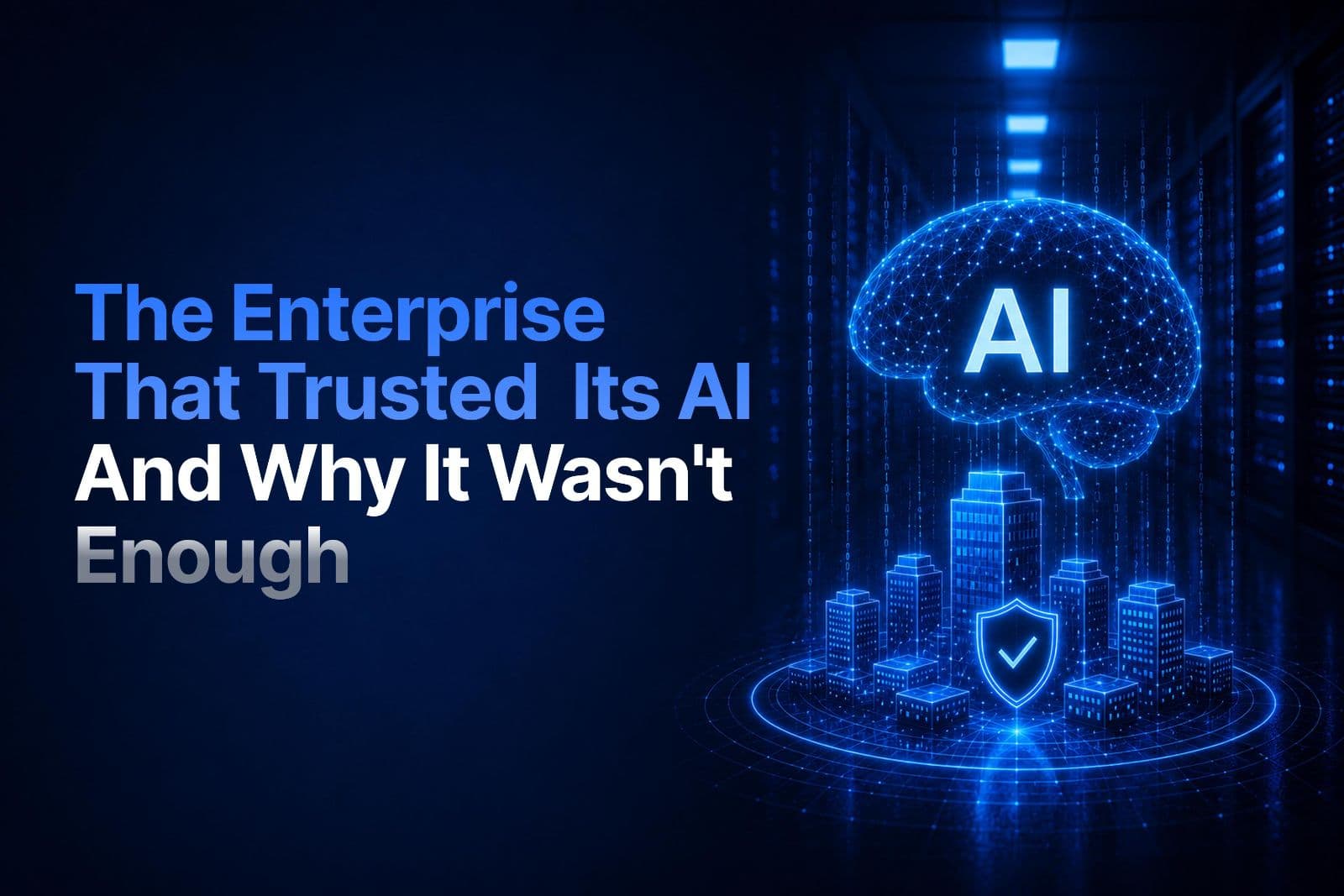
The enterprise in our scenario didn't fail because its AI wasn't sophisticated enough. It failed because it built the future without fixing the foundation.
The foundation is fixable. The time to fix it is now.